
Selecting more than one file at a time lets you do the same thing to all of them in one go, rather than one by one. It’s a great time saver.
For example, if you wanted to delete 20 old photos, you could delete them one at a time. That would get the job done. A much quicker way is to select multiple files together and delete them all at once.
There are four main ways to select multiple files in Windows, and I’ll show you all of them in File Explorer. They work for photos, documents and folders, in Windows 11 and Windows 10, and on your desktop too. After that I’ll show you how to do it with just the keyboard or a laptop touchpad.
The Short Version
- Click and drag a box around the files to select a group.
- Ctrl + click to pick files one at a time, anywhere in the folder.
- Shift + click the first and last file to select everything in between.
- Ctrl + A to select everything in the folder.
- Changed your mind about one? Ctrl + click it again to deselect it.
Table of contents
- Click and Drag to Select Multiple Files
- Ctrl + Click to Select Files That Aren’t Next to Each Other
- Ctrl + A to Select All Files in a Folder
- Shift + Click to Select a Group of Files
- How to Deselect a File
- How to Select Multiple Photos
- How to Select Multiple Files with the Keyboard
- How to Select Multiple Files on a Laptop Touchpad
- What to Do with Your Selected Files
- If Selecting Multiple Files Goes Wrong
- Frequently Asked Questions
- Summary
Click and Drag to Select Multiple Files
Click and drag, also known as drag select, is probably the easiest method to get started with. You draw a box around the files, a bit like casting a net over them.
- Move your mouse pointer into an empty space as close as you can get to the first file you want, but not touching any files or folders.
- Hold down the left mouse button and move the pointer over the files you want. A see-through box appears, and every file it touches becomes highlighted.
- Keep the button held down the whole time, then let go when all the files you want are inside the box.


Drag select is quick, but it can take a little practice to get right, especially when the files are packed tightly together.
Ctrl + Click to Select Files That Aren’t Next to Each Other
This is my favourite way of selecting multiple files in Windows. It doesn’t take any practice at all. It’s very precise, and quick when you only have a few files to pick.
- Left-click once on the first file you want. The usual highlight appears around it.
- Hold down the Ctrl (Control) key on your keyboard.
- Keep holding Ctrl and left-click once on each of the other files or folders you want. Each one is highlighted as you click it, which is called “adding to the selection”.
- Let go of Ctrl when you have them all.
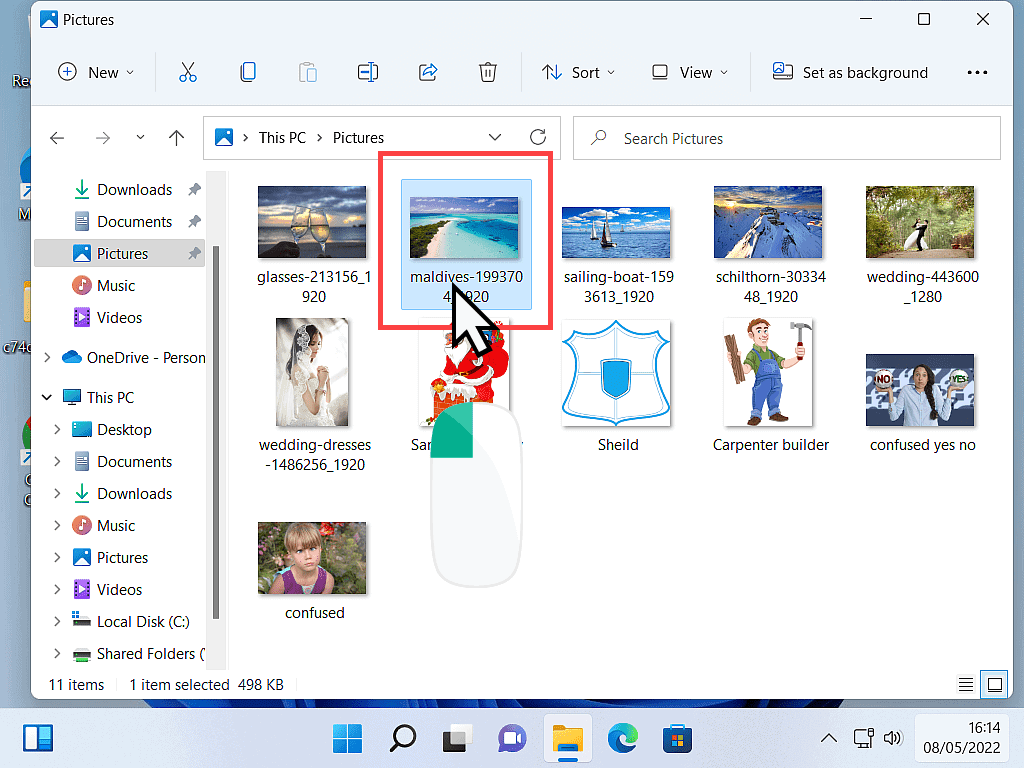

Only the files you actually click are selected, and they don’t need to be next to each other. You can jump around the folder and even scroll up or down, as long as you hold Ctrl each time you click.

Ctrl + A to Select All Files in a Folder
Sometimes you want everything inside a folder, all the files and all the folders inside it.
Hold down the Ctrl key and press the letter A. Every file and folder is selected instantly. This is known as Select All.
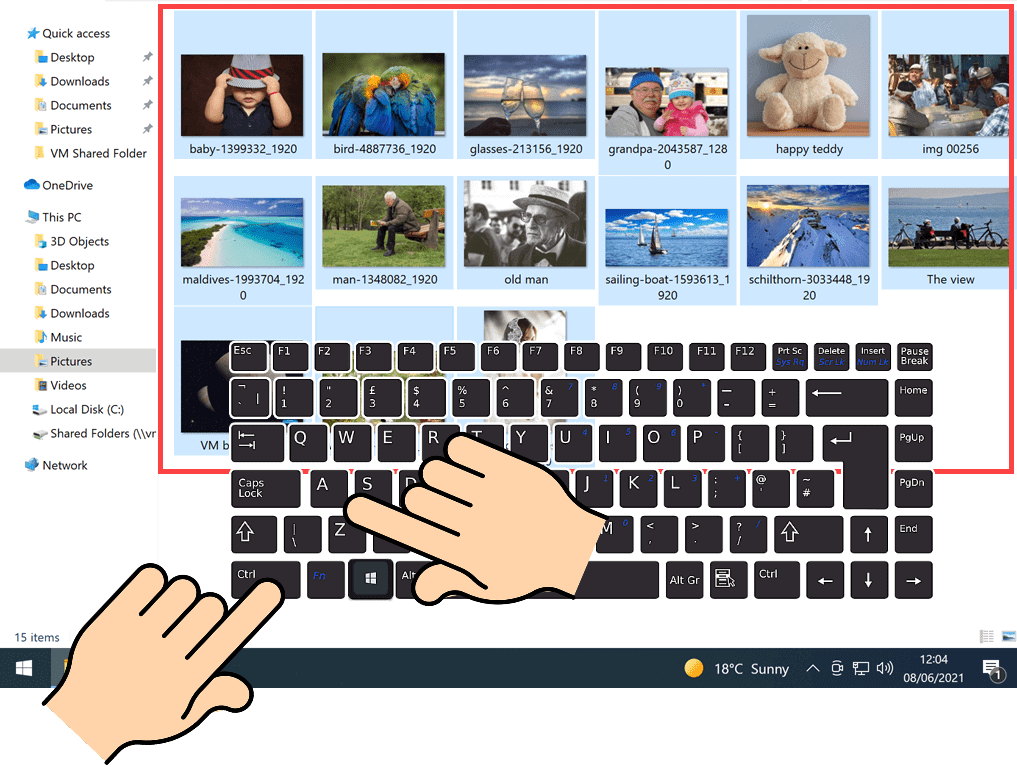
Quick Note
You could select everything with click and drag or Ctrl + click, and both would work. But Ctrl + A is instant, and it has one big advantage: it also selects the files you can’t see.
A folder often holds more files than fit on your screen, so some only appear when you scroll down. Ctrl + A picks those up too.
Select All, Select None and Invert Selection
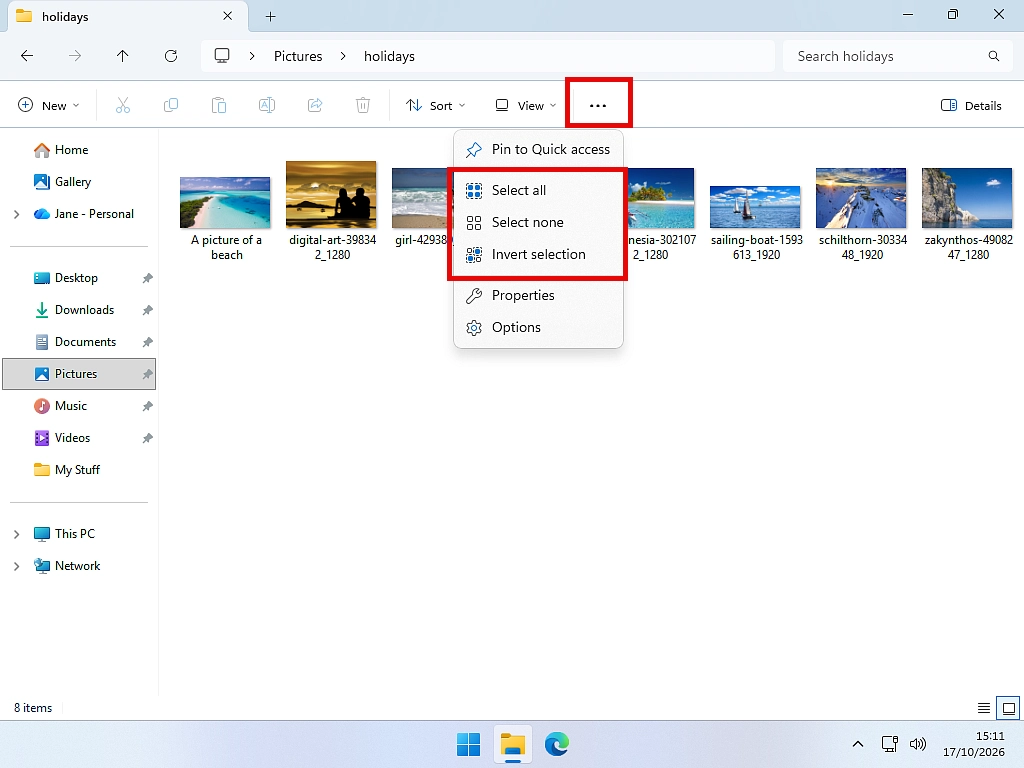
If you’d rather use the mouse, Select All is also on the menus, along with two handy partners:
- Windows 11: click the three dots (See more) on the toolbar at the top of File Explorer.
- Windows 10: click the Home tab and look at the right-hand end of the ribbon.
You’ll see Select all, Select none (clears everything) and Invert selection. Invert selection swaps it round, so everything you had selected is deselected and everything else is selected.
That makes it the quickest way to select all the files except one. Click the file you don’t want, then choose Invert selection.
Shift + Click to Select a Group of Files
Shift + click is the one to use when the files you want are next to each other, in a line or a block. You could click and drag over them, or Ctrl + click each one, but Shift + click is quicker and you can’t miss one.
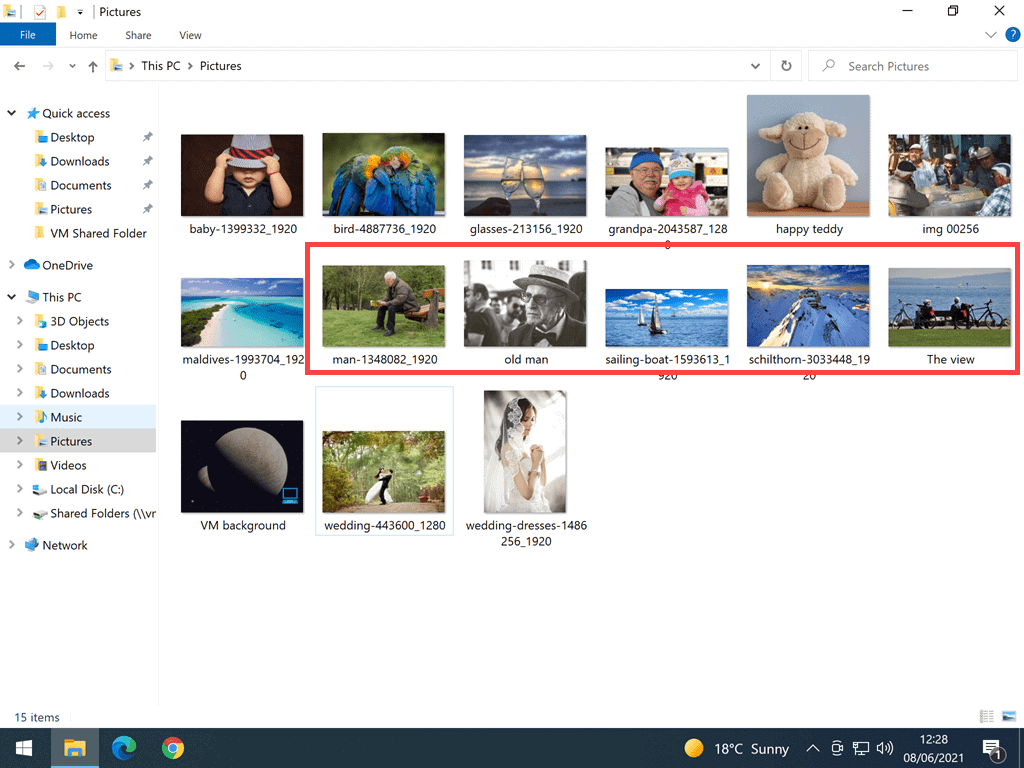
- Left-click once on the first file or folder you want. It’s highlighted as usual.
- Hold down the Shift key on your keyboard.
- Left-click once on the last file or folder you want.


Every file and folder between the first and the last is selected.

The files don’t have to be in a straight line. They just need to be in an unbroken run from the first file to the last, which means it can wrap round onto the next row.

How to Deselect a File
Picked one too many? You don’t have to start again.
With your files selected, hold down Ctrl and left-click once on the file you want to drop. That one file is deselected and everything else stays selected.


How to Deselect Everything
To clear the whole selection, click once on an empty space in the folder. Or use Select none from the menu I mentioned above.
How to Select Multiple Photos
Photos are what most people are selecting, whether it’s to copy them to a USB stick, delete the blurry ones or send a few to family.
In File Explorer
Everything above works exactly the same in your Pictures folder. It’s much easier when you can actually see the pictures, though, so make sure File Explorer is set to Large icons and that it’s set to show thumbnails instead of icons.
Then use Ctrl + click to pick out the photos you want, or Shift + click for a run of photos from the same day.
In the Photos App
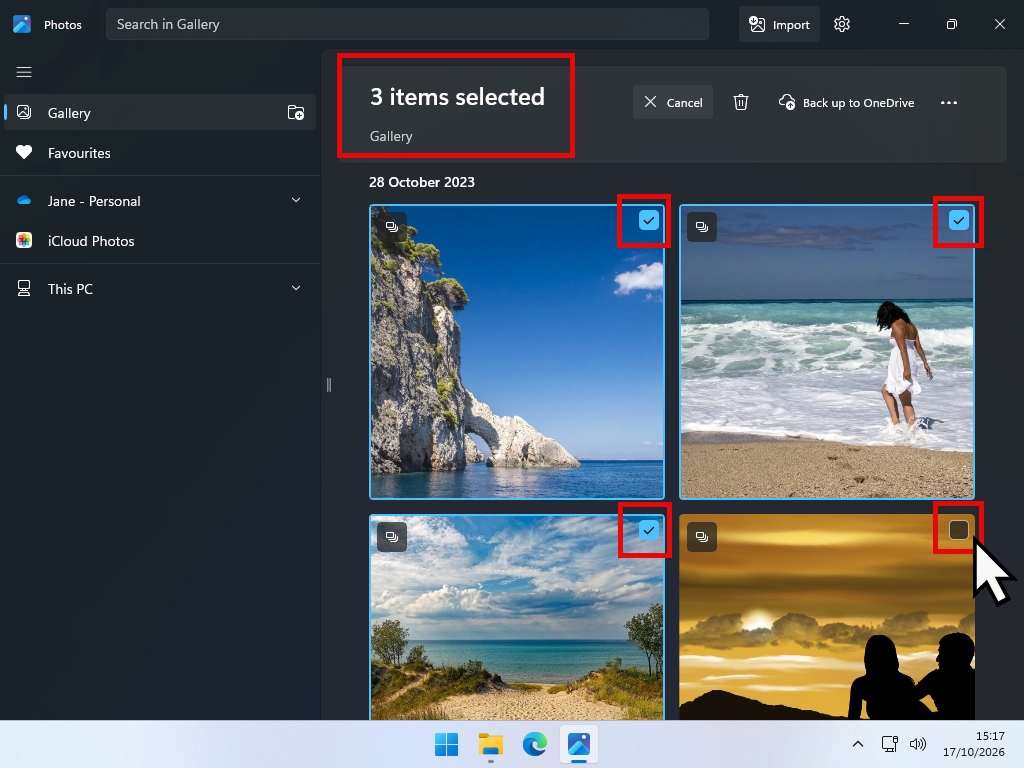
If you browse your pictures in the Windows Photos app instead, point at a photo and click the small tick box that appears in top left corner. Then tick each of the other photos you want.
How to Select Multiple Files with the Keyboard
If you find the mouse awkward, or it’s playing up, you can select files with the keyboard alone. Click the first file you want so Windows knows where to start, then:
- Shift + arrow keys: select the next file along, and keep going. Each press adds another file.
- Ctrl + arrow keys, then Spacebar: hold Ctrl and use the arrows to move the outline to another file without losing what you have, then press Spacebar to add it. This is the keyboard version of Ctrl + click.
- Ctrl + A: select everything in the folder.
These keys work the same in Windows 11 and Windows 10, and on the desktop as well as in folders. In a document or an email, the same keys select text rather than files, and Ctrl + A selects all the text instead.
How to Select Multiple Files on a Laptop Touchpad
A touchpad makes click and drag fiddly, but all of these methods still work on a laptop.
Drag to Select with a Touchpad
Tap twice on the touchpad, and on the second tap leave your finger down and slide it across the files. Lift your finger when they’re all in the box.
If that doesn’t work, check the setting is on. In Windows 11 go to Settings, then Bluetooth & devices, then Touchpad, open Taps and tick Tap twice and drag to multi-select. It’s on by default.
If your touchpad has a physical button, you can also hold the button down with one finger and slide another finger across the pad.
Ctrl + Tap
Ctrl + click works with a tap too. Hold down Ctrl on the keyboard and tap each file on the touchpad. Shift + tap works the same way for a group.
The Easy Way: Turn On Item Check Boxes
This is the one I’d suggest for anyone who finds selecting fiddly, on a laptop or not. Windows can put a tick box on every file, so you just tick the ones you want. No keys to hold down.
- Windows 11: click View on the toolbar, then Show, then Item check boxes.
- Windows 10: click the View tab, then tick Item check boxes.
Now point at any file and a small box appears in its corner. Click the box to select the file, and click it again to deselect it. Clicking the file itself still works normally.
What to Do with Your Selected Files
Once your files are selected, anything you do happens to all of them at once:
- Copy them: press Ctrl + C. Copy and paste them into another folder.
- Move them: press Ctrl + X. Cut and paste them somewhere else.
- Delete them: press the Delete key. They all go to the Recycle Bin together, so you can get them back if you change your mind.
- Rename them: press F2, type a name and press Enter. Windows gives them all that name with a number on the end, such as Holiday (1), Holiday (2) and so on.
- Drag them: drag any one of the selected files and the rest come with it, which is an easy way to copy them onto a USB stick.
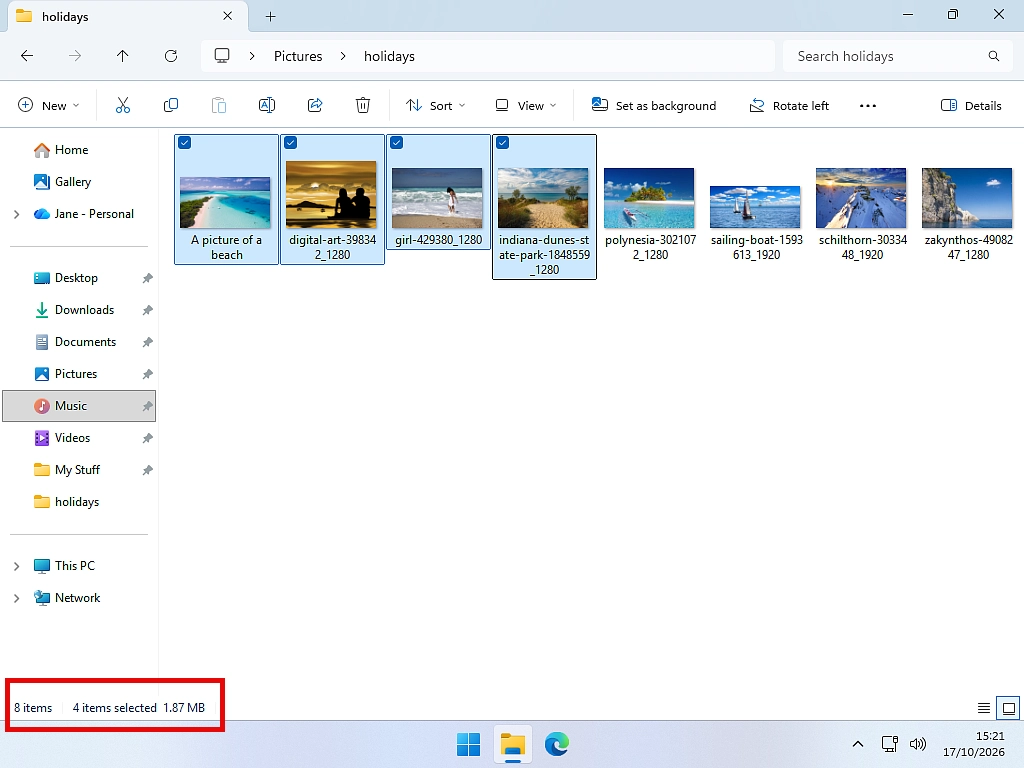
Before you do anything, glance at the bottom left corner of the File Explorer window. It tells you how many items are selected, so you know you’ve got them all.
If Selecting Multiple Files Goes Wrong
I Clicked and Lost All My Selections
Clicking a file without holding Ctrl starts a brand new selection, so everything else is dropped. Your files are fine, nothing has happened to them. Just select them again, and keep Ctrl held down while you click.
Click and Drag Moved My Files Instead
If you start the drag on a file rather than in an empty space, Windows picks the file up and moves it. Press Ctrl + Z straight away to put it back. Next time, start the drag in an empty area, such as just below the last file.
Ctrl + A Selected Text, Not Files
If the address bar or the search box at the top of File Explorer is active, Ctrl + A selects the text in that box. Click once on an empty space among the files, then press Ctrl + A again.
Frequently Asked Questions
Q: Which key do you hold to select files that aren’t next to each other?
A: Hold down the Ctrl key while you click each file. To select a block of files that are next to each other, use the Shift key instead: click the first file, hold Shift and click the last.
Q: How do I select all the files in a folder except one?
A: Press Ctrl + A to select everything, then hold Ctrl and click the file you want to leave out. Or click just that one file and choose Invert selection from the menu.
Q: How do I know how many files I’ve selected?
A: Look at the bottom left corner of the File Explorer window. It shows how many items are selected, and for files it also shows their total size.
Q: Can I select files from different folders at the same time?
A: Not by clicking, because a selection only works inside one folder. The way round it is to search. Open the main folder, type a word in the search box at the top of File Explorer, and the results include matching files from every folder inside it. You can select those all together.
Q: How do I select multiple files on a laptop without a mouse?
A: Hold Ctrl and tap each file on the touchpad, or use Shift + arrow keys on the keyboard. The easiest way of all is to turn on Item check boxes in the View menu and tick the files you want.
Summary
Whether you want to copy, move, delete or rename them, selecting multiple files and folders makes life a lot easier:
- Click and drag casts a net over a group of files.
- Ctrl + click adds files to the selection one at a time, wherever they are.
- Ctrl + A selects everything in a folder, even the files off screen.
- Shift + click selects a run of files from the first to the last.
- Ctrl + click on a selected file deselects it.
If you find it fiddly, especially on a laptop, turn on Item check boxes and just tick the files you want.
Next Lesson
Copy Files to USB Flash Drive
We can select one or more files/folders, copy and paste or cut and paste. Now let’s do something useful. Copy files to a USB flash drive.
Course Progress – 14 of 37 done.
Part of the At Home Beginner Computer Course.
Previous Lesson
How to Copy and Paste Text
Copy and paste text from emails, web pages and virtually any other sort of document.