
You’ve forgotten your computer password or PIN, and now you’re locked out of your own PC. It’s a horrible feeling, but in most cases you can get back in. Let me walk you through what actually works in 2026, and what to do if it doesn’t.
The first thing that matters is whether you sign in to Windows with a Microsoft account or a local account. Here’s the difference between the two.
If you use a local account, you’re in luck, getting back in is usually straightforward. This guide covers resetting a forgotten local account password.
But if you’ve forgotten the password for a Microsoft account, things are trickier, and a well-known trick that used to work no longer does. Here’s where you really stand.
Everything below comes down to one thing: can you still get a code sent to the recovery email address or phone number on your Microsoft account? If you can, you’ll be back in within minutes. If you can’t, you’re in real trouble, and I’ll be honest with you about what’s left.
The Short Version
You don’t need the password to get back into Windows. On the sign-in screen click I forgot my PIN, confirm your recovery email address (or phone number, if that’s what’s on your account) and click Send code. Enter the code Microsoft sends you, click Reset PIN, and set a new PIN. You’re back in, with all your files and settings exactly as you left them.
Then reset your password straight away. The new PIN gets you into the PC, but away from it, and for some changes inside your account, you’ll still need the password. Everything depends on that code, though. If your recovery email and phone are out of date, read on, because things get a lot harder.
Table of contents
- First: Is It Your Password or Your PIN You’ve Forgotten?
- You Can’t Find Your Password, You Can Only Reset It
- How to Get Back Into Windows Without Your Password
- How to Reset a Forgotten Microsoft Account Password
- No Access to Your Recovery Email or Phone?
- The Old Command Prompt Trick No Longer Works
- If You Can’t Get the Account Back: Your Files and BitLocker
- Starting Over: Wipe and Reinstall Windows
- How to Avoid Being Locked Out Again
- Troubleshooting
- Frequently Asked Questions
- Summary
First: Is It Your Password or Your PIN You’ve Forgotten?
This trips a lot of people up, so let’s clear it up before anything else. On most Windows 11 PCs you don’t type your full password to sign in, you type a short PIN. On many newer PCs the sign-in screen doesn’t even offer the password any more, only the PIN. The PIN and the password are two different things.
Here’s how most people end up locked out. When you set the PC up, Windows pushed you to create a long, strong password, and then had you set up a short PIN to sign in with day to day. From that point on you only ever type the PIN. A year or two later, when something finally asks for the password again, it’s long gone. You’re not daft, you simply haven’t needed it since.
If you’ve only forgotten the PIN, but you still know your Microsoft account password, this is an easy fix. On the sign-in screen click I forgot my PIN, choose Use your password instead, type your password, and then set a new PIN. Two minutes and you’re in.
If you’ve forgotten the Microsoft account password as well, don’t panic. As long as you can still get to your recovery email or phone, you don’t need the password to get back in. I’ll show you how below.
Quick Tip
A PIN only works on the one device you set it up on. Your password is for your whole Microsoft account, everywhere. That’s why forgetting the password is the bigger headache.
You Can’t Find Your Password, You Can Only Reset It
A lot of people search for how to find their Microsoft account password, hoping there’s a way to look up the one they had. I’ll be straight with you: there isn’t.
Microsoft never stores your password in a form that anyone, including Microsoft, can read back to you. What you can do instead is reset it, replacing the old password with a new one that you choose. And as you’ll see next, you don’t even need it to get back into Windows.
How to Get Back Into Windows Without Your Password
Here’s the good news. To get back into Windows you don’t need your password at all. A code sent to your recovery email or phone is enough to reset your PIN. You just need the PC connected to the internet, and your phone or another device where you can read the email or text.
On the sign-in screen, under the PIN box, click I forgot my PIN.
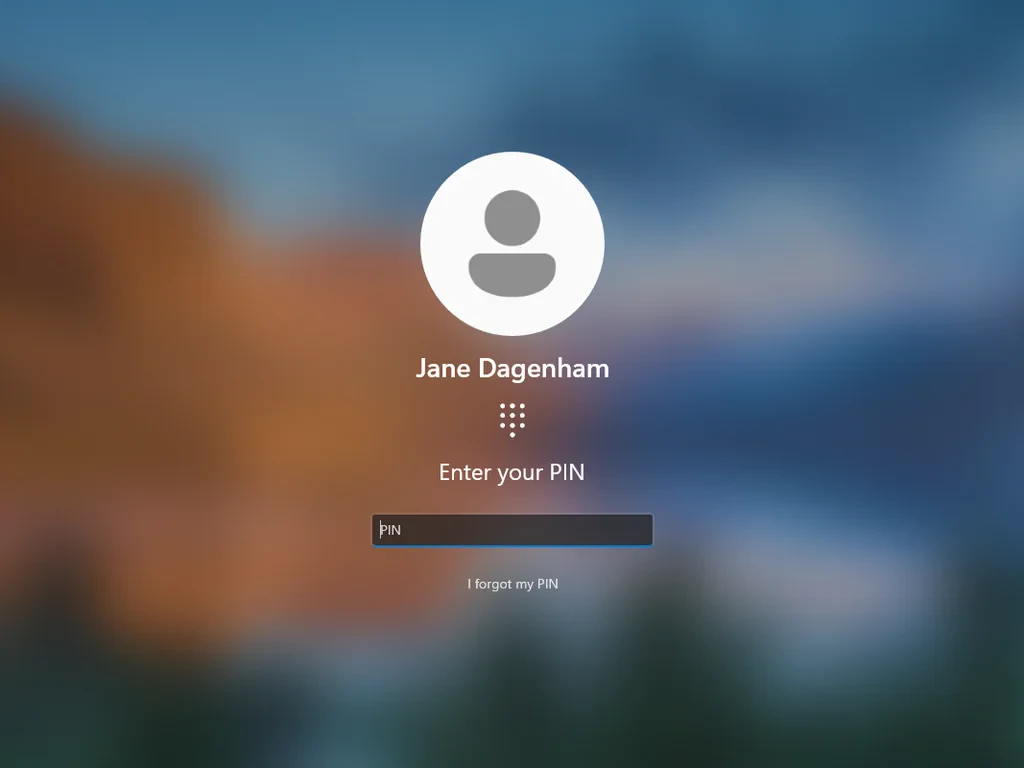
A Microsoft account window opens and asks you to verify your email. Microsoft shows you a hint of your recovery email address. Type the full address into the box, then click Send code.
If your account has a recovery phone number, you’ll be offered a text message instead, or as well. Microsoft shows you the end of the number and asks you to fill in part of it to prove it’s yours, then texts you the code.
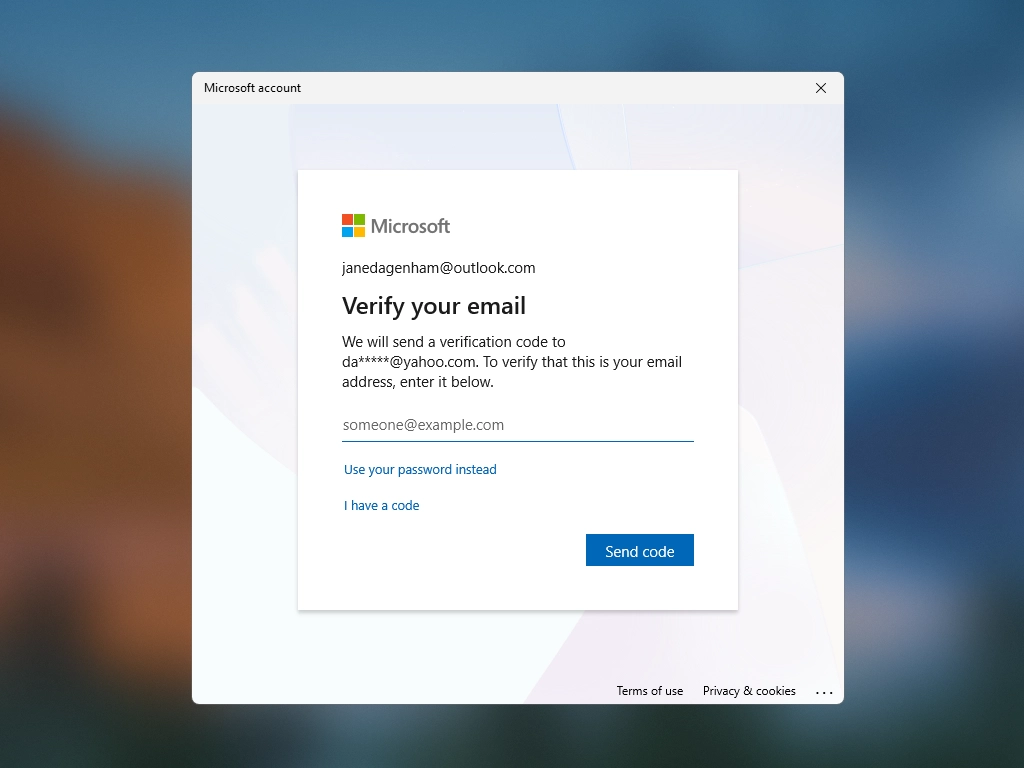
Check that email, or the text on your phone, then type in the code Microsoft has sent you.
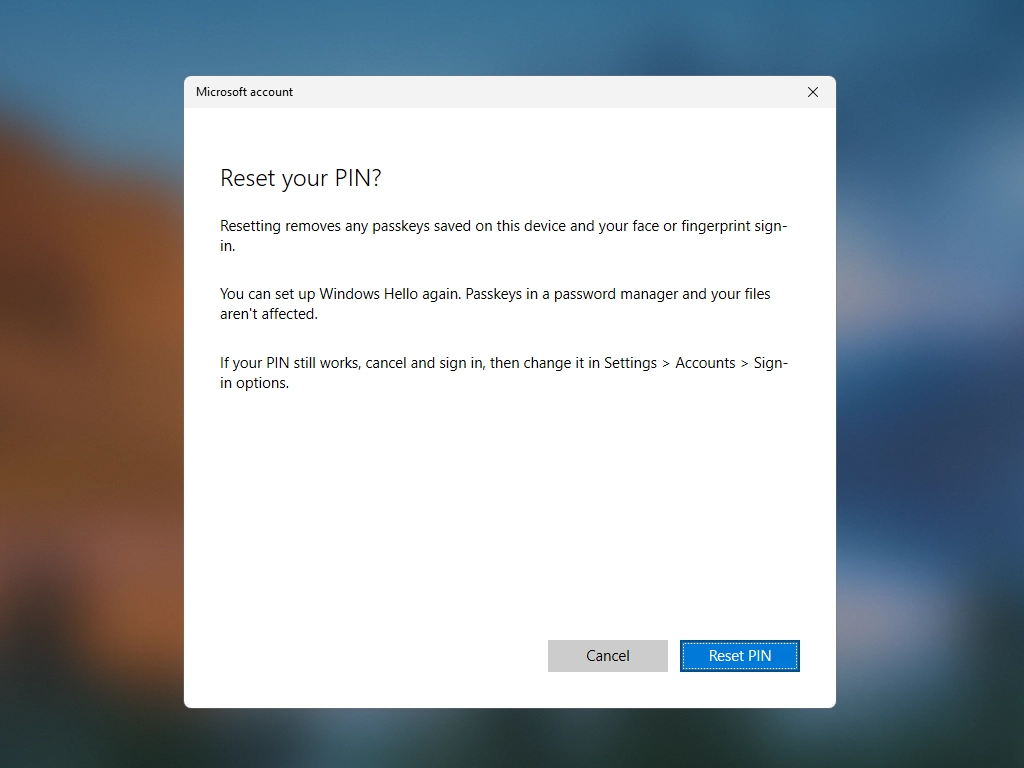
Windows asks Reset your PIN? Click Reset PIN.
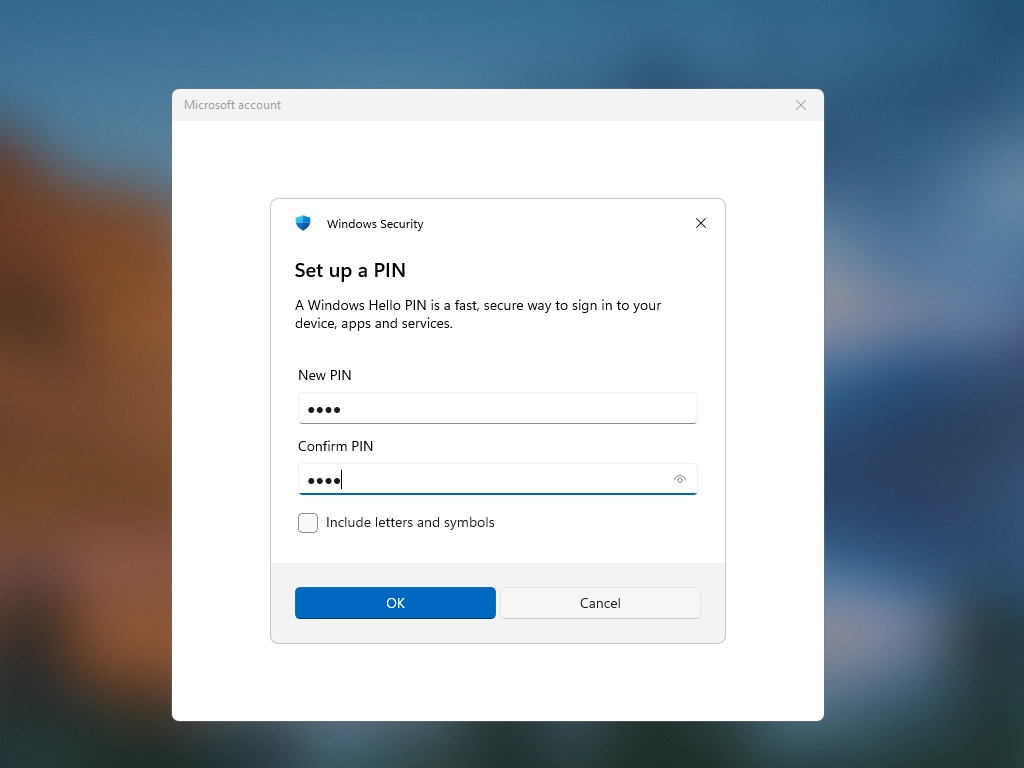
Type a new PIN into New PIN and again into Confirm PIN, then click OK. Tick Include letters and symbols if you want a stronger PIN.
And you’re back into your PC, with every file, program and setting exactly as it was.
But don’t stop there. On this PC your new PIN may well get you into your Microsoft account online too, because Windows lets the PIN stand in for the password. But the password itself is still forgotten. Away from this PC, on your phone or another computer, you’ll still be asked for it. And some changes inside your account, like updating your recovery phone number, ask for the password and won’t take a PIN.
So reset the password straight away, while you’ve got your recovery email or phone to hand. The next section shows you how.
Face or Fingerprint Sign-In
Resetting your PIN also removes face and fingerprint sign-in, and any passkeys saved on this PC. Your files aren’t touched. Once you’re back in, you can set face or fingerprint up again in Settings › Accounts › Sign-in options.
How to Reset a Forgotten Microsoft Account Password
Now for the password itself. Like everything else here, you’ll need access to the recovery email address or phone number on your account.
Reset It in Your Web Browser
This is the easiest way, and it works on your phone, on another computer, or on the PC you’ve just got back into. Open your web browser and go to the Microsoft password reset page.
Enter your Microsoft account email address, get a code sent to your recovery email or phone, type the code in, and create a new password. The pages look just like the screens in this guide.
Reset It From the Windows Sign-In Screen
If you’d rather do it before you get back into Windows, you can. On Windows 11 there’s no forgot password link on the sign-in screen itself, which catches a lot of people out. The way in is through I forgot my PIN.
Click I forgot my PIN, just like above, but on the Verify your email screen click Use your password instead. Then on the Enter password screen, click Forgot password?
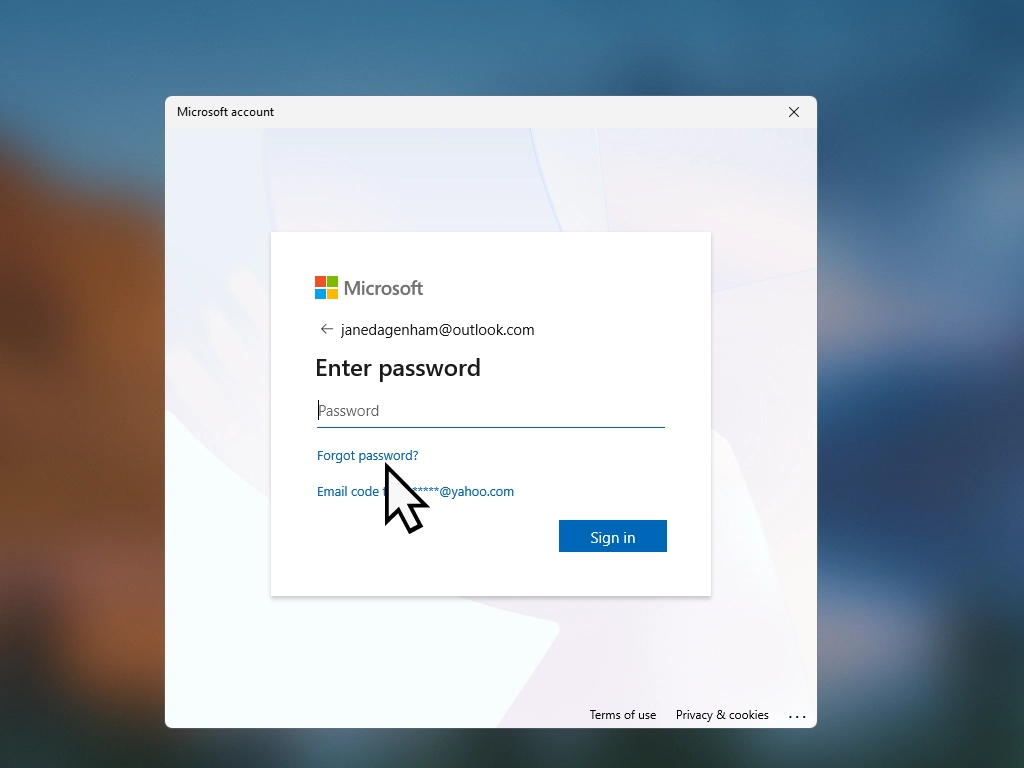
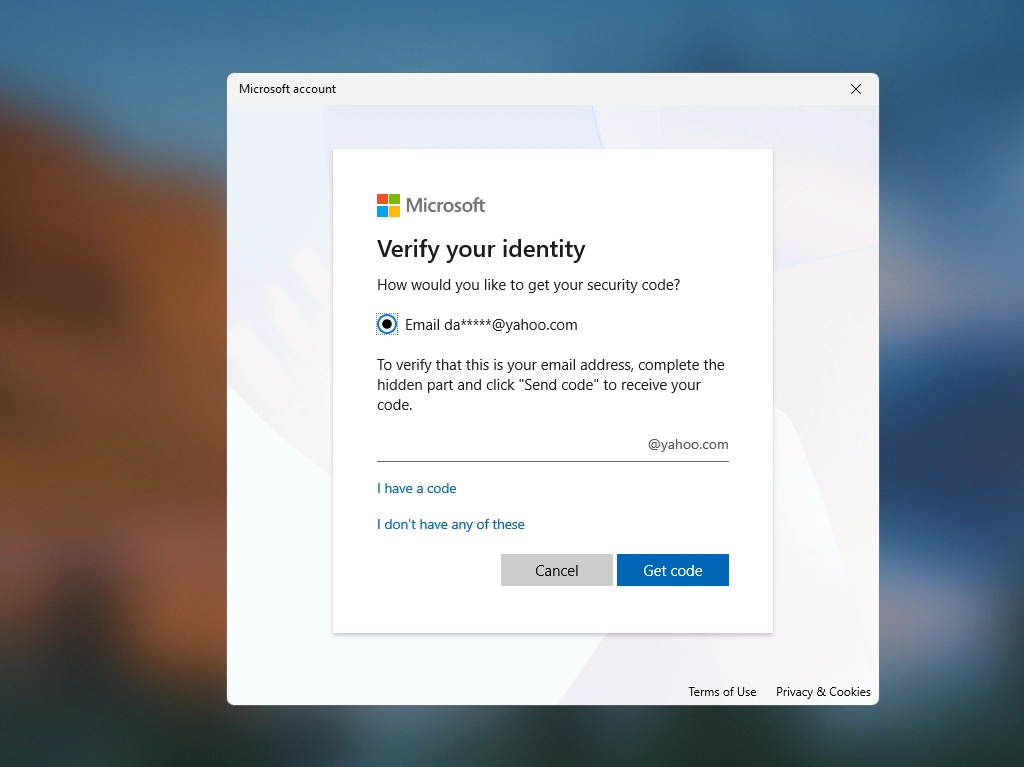
On the Verify your identity screen, choose your recovery email or phone, type in the hidden part of it, and click Get code.
Enter the code Microsoft sends you and create your new password. Sign in with it if Windows asks, and it then takes you through Reset PIN and Set up a PIN, just like above. You’re back in with both a new password and a new PIN.
You’ll Need a Recovery Email or Phone
Every one of these routes ends in the same place: Microsoft sending a code to the recovery email or phone on your account. If you can’t get to either of those any more, the next section is for you.
No Access to Your Recovery Email or Phone?
This is where you’re in real trouble, and I’m going to be honest with you rather than give you false hope.
If you can’t receive the code because the email address and phone number on the account are old and gone, click I don’t have any of these on the Verify your identity screen. That takes you to your only remaining route, the Microsoft account recovery form. You fill in as much as you can remember: old passwords you’ve used, roughly when you created the account, people you email regularly, and so on. Microsoft’s system then decides, automatically, whether it believes you own the account.
Fair warning: plenty of people fill this in with completely genuine, accurate details and still get turned down. For a personal account there’s no human you can appeal to. It does help to fill it in from a device and internet connection you’ve used with the account before.
If the form won’t verify you, then the account, and anything tied only to it, is effectively lost. I know that’s not what you want to hear, but it’s better to know where you stand.
The Old Command Prompt Trick No Longer Works
You may come across older guides, mine included until now, telling you to boot from a Windows USB stick, swap the utilman.exe file for cmd.exe, and create a brand new administrator account right from the sign-in screen. For years that was the reliable way back in.
I’ve tested it on a fully updated Windows 11 machine, and it’s dead. Windows Defender now recognises the swapped file as a threat and quietly blocks it. You click the Accessibility icon expecting a Command Prompt, and nothing happens at all.
So please don’t spend your afternoon on it. It won’t get you in, and if your drive is encrypted you can’t even make the change in the first place. The reset routes above are your real options.
If You Can’t Get the Account Back: Your Files and BitLocker
If the account really is unrecoverable, the next question is whether you can rescue your files before you start over. That comes down to one thing: whether your drive is encrypted.
If BitLocker or Device Encryption Is On
Recent Windows 11 PCs quietly encrypt the drive the first time you sign in with a Microsoft account. This is Device Encryption, Windows 11’s version of BitLocker, and most people have no idea it’s switched on.
The key that unlocks that encryption is stored in the same Microsoft account. So if you’ve lost the account, you’ve lost the key, and the files on the drive are scrambled and unreadable. There’s no clever way around it, that’s the whole point of encryption.
In plain terms: with encryption on and the account gone, both your online data and your local files are out of reach.
If Encryption Is Off
If your drive isn’t encrypted, you’re in a much better position. You can still get your files off it even though you can’t sign in to Windows.
Boot the PC from a live Linux USB stick. Linux Mint and Ubuntu both have a Try option that runs straight from the stick without touching your hard drive. Once it’s running, you can open your Windows drive and copy your documents, photos, videos and anything else onto an external drive.
With your files safely copied off, you can then wipe and reinstall Windows without losing anything that matters.
Starting Over: Wipe and Reinstall Windows
If the account’s gone for good, the PC itself is still perfectly fine. You just reinstall Windows and set it up fresh with a new account.
You’ll need Windows installation media on a USB stick. Here’s how to make one for Windows 10 or for Windows 11.
Boot from the stick and choose to install Windows fresh. This wipes the old locked account and everything on the drive, so only do it once you’ve rescued any files you need (and remember, if the drive was encrypted, those files can’t be rescued).
When you set the PC up again, you can sign in with a different Microsoft account, create a new one, or set it up with a local account instead so you’re never locked out like this again.
How to Avoid Being Locked Out Again
Since everything hinges on your recovery email and phone, the most useful thing you can do takes two minutes. If you can still sign in, do it now, before you ever need it.
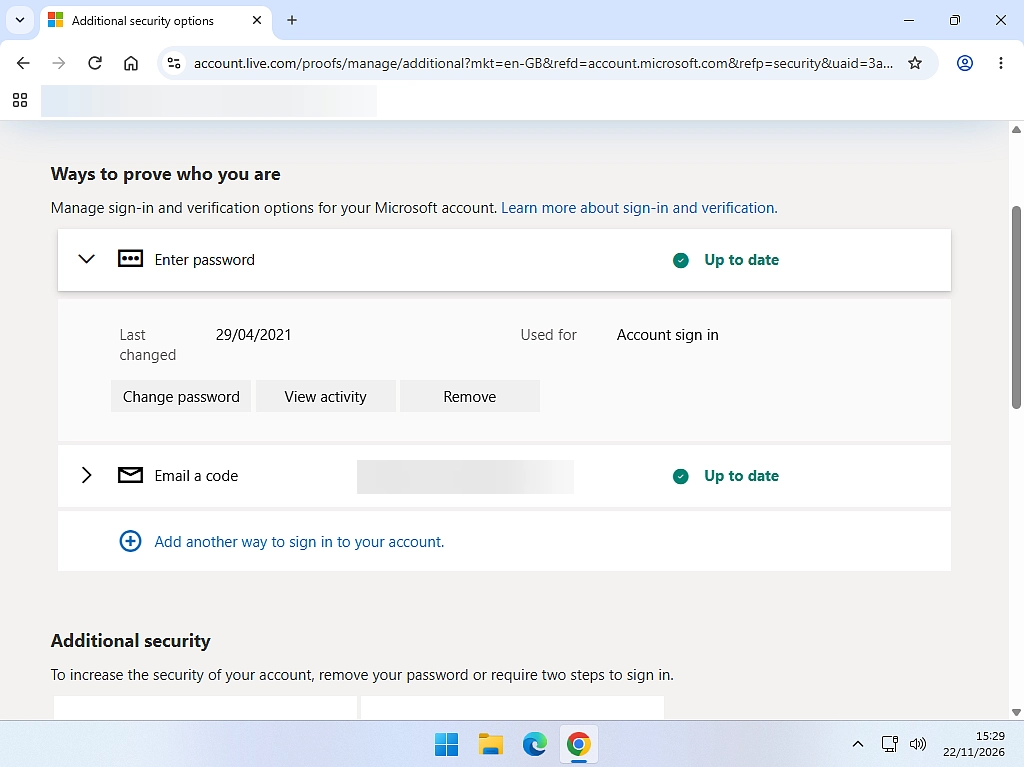
Sign in to your Microsoft account at account.microsoft.com, click Security in the left-hand panel, then click Manage how I sign in.
Under Ways to prove who you are you’ll see the email addresses and phone numbers Microsoft can send codes to. Make sure every one is an address or number you can still get to. If there’s only one, click Add another way to sign in to your account and add a second, ideally a mobile number as well as an email.
While you’re at it:
- Write your Microsoft account password down and keep it somewhere safe at home, away from the PC. With a PIN doing the everyday sign-ins, it’s very easy to forget.
- Back up your BitLocker recovery key. You can save it to a file or print it, just keep a copy somewhere that isn’t on the PC itself.
- If you’d rather not depend on Microsoft to get back in at all, switch to a local account.
Troubleshooting
I Can’t Find a Forgot Password Link
On Windows 11 there isn’t one on the sign-in screen. Click I forgot my PIN first, then Use your password instead, and you’ll find Forgot password? on the next screen.
If the Microsoft account window won’t open, the PC probably isn’t online. Connect to Wi-Fi using the network icon in the bottom right corner of the sign-in screen and try again. And if none of the screens mention Microsoft at all, you’re probably on a local account, so use the local account reset instead.
I Reset the Password But Still Can’t Sign In
Make sure the PC is connected to the internet so it can check your new password with Microsoft, and give it a minute to catch up. If Windows drops you back at the PIN screen, click I forgot my PIN again, choose Use your password instead, enter your new password, and set a new PIN.
I’m Stuck Going Round the Verify-Identity Loop
If Microsoft keeps asking for a verification method you no longer have, click I don’t have any of these on the Verify your identity screen. That’s what sends you to the account recovery form.
It’s Asking for a BitLocker Recovery Key
Your drive is encrypted. Sign in to your Microsoft account on another device, go to the BitLocker recovery key page, and you’ll find the 48-digit key there to type in.
Frequently Asked Questions
Q: Can Microsoft just tell me my old password?
A: No. They can’t see it and can’t retrieve it. The only thing they can help with is resetting it to a new one that you choose.
Q: I’ve forgotten my PIN but not my password, what do I do?
A: Click I forgot my PIN on the sign-in screen, choose Use your password instead, type your password, then set a new PIN. It’s a quick, easy fix.
Q: Can I get back into Windows without my Microsoft account password?
A: Yes, as long as you can get to your recovery email or phone. Click I forgot my PIN, get a code sent to your recovery email or phone, enter the code, then reset your PIN. You don’t need the password at all to get back into the PC.
Q: I’ve reset my PIN, do I still need to reset my password?
A: Yes. On that PC your new PIN may even get you into your Microsoft account online, but away from it you’ll still be asked for the password. Some changes inside the account, such as updating your recovery phone number, also ask for the password and won’t accept a PIN. So reset it while you have your recovery email or phone to hand.
Q: Will resetting my PIN or password delete my files?
A: No. Your files aren’t touched either way. Resetting the PIN does remove face or fingerprint sign-in and any passkeys saved on the PC, but you can set those up again.
Q: Does the utilman and cmd trick still work?
A: No. Windows Defender now blocks it, so on an up-to-date PC clicking the Accessibility icon does nothing at all.
Q: Can I get my files back if I can’t recover the account?
A: Only if the drive wasn’t encrypted. If BitLocker or Device Encryption was on, the files are locked away with the account and can’t be recovered.
Q: How do I know if my drive is encrypted?
A: If it ever asks for a 48-digit recovery key when it starts up, it’s encrypted. You can also check Device Encryption in Settings while you’re signed in.
Q: Is there software that resets a Microsoft account password offline?
A: Some tools claim to, but they’re unreliable for Microsoft accounts and useless on an encrypted drive. The official reset is safer and far more likely to actually work.
Q: Can I reset my Microsoft password without a recovery email or phone?
A: Only through the account recovery form, which is automated and often turns people down even when their details are right. Without a working recovery email or phone there is no other official way, and Microsoft support can’t do it for you.
Q: Why is there no forgot password link on the Windows 11 sign-in screen?
A: Because Windows 11 signs you in with a PIN. Click I forgot my PIN, then Use your password instead, and you’ll find Forgot password? on the next screen.
Q: How do I stop this happening again?
A: Check the recovery email and phone on your account are up to date, write your password down somewhere safe at home, and back up your BitLocker key.
Summary
Forgetting your Microsoft account password is a real headache, but for most people it’s fixable. As long as you can still get to your recovery email or phone, a code is all it takes to reset your PIN and get back into Windows, with nothing lost.
Then reset the password too, because away from that PC, and for some changes inside your account, you’ll still need it.
The important change to know about is that the old trick of creating a new admin account from the sign-in screen no longer works. And if your drive is encrypted, recovering your account is the only way back to your files, because the key is locked inside it.
Everything comes down to your recovery email and phone. Without them you’re in real trouble. So the best thing you can do, long before you ever need it, is check they’re up to date, write your password down somewhere safe, and back up your BitLocker key.
Good luck.
Related Posts
How to Reset a Forgotten Windows Password (local accounts).
How to Create a New Windows User Account.
How to Install Windows Without a Microsoft Account.
How to Open and Convert Publisher Files to Word or PDF, Even Without Publisher
Publisher has gone from Microsoft 365 and Office 2024.
How to open your .pub files without it, save them as PDF and get them into Word, free, with or without Publisher.
You can find this and other related step by step guides in – At Home Computer Guides
Written by Jeff Porter. I’ve been fixing Windows PCs since 2010 and I’m CompTIA Network+ certified. More about me