
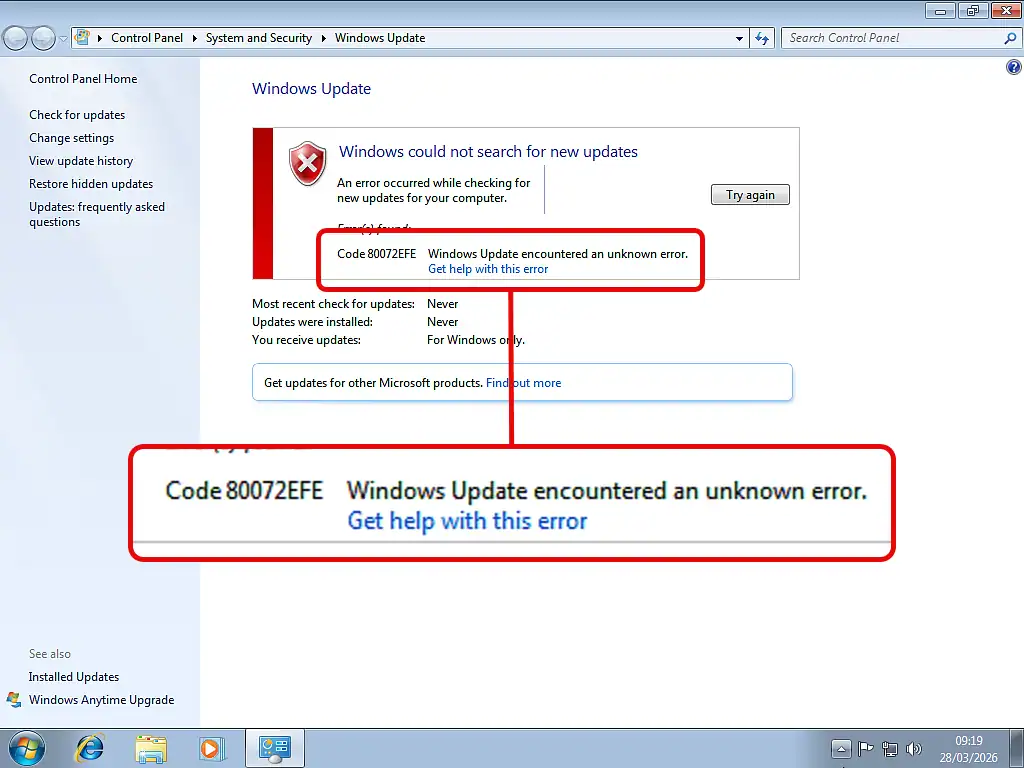
If you’ve recently reinstalled Windows 7 on a physical PC or maybe set up a Windows 7 Virtual Machine (VM), you’ll most likely find that Windows Update is broken. You might see the error “Windows could not search for new updates“, get stuck on Error 80072EFE, or find the system is “checking for updates” forever.
While Microsoft ended support for Windows 7 years ago, the update servers are still online. The problem is that a fresh install lacks the modern security certificates and “Servicing Stack” required to talk to them.
In this guide, I’ll show you how to fix Windows 7 updates not working in 2026 using the manual patch method and the ISO workaround for Virtual Machines.
Why is Windows 7 Update Stuck?
The most common reasons for Windows 7 update failure in 2026 are:
- Outdated Update Client: The original Windows 7 agent doesn’t understand modern encryption.
- Error 80072EFE: This specific code usually means your PC cannot establish a secure connection to Microsoft’s servers.
- The “Search Loop”: The update agent gets stuck in an infinite loop trying to calculate dependencies.
The Solution: Manual Patching (KB3020369 & KB3125574)
To get the automatic updater working again, you’ll need to manually install two specific updates in the correct order.
Step 1: Install KB3020369 (Servicing Stack Update)
This update prepares the system to handle the larger “Convenience Rollup” which you’ll install next. It’s available for both 32-bit (x86) and 64-bit (x64) versions of Windows 7.
- Download KB3020369 (32-bit) – You’ll need this one for 32 bit versions of Windows 7.
- Download KB3020369 (64-bit) – And this one is the same update but for 64 bit versions.
Step 2: Install KB3125574 (The “Service Pack 2” Rollup)
This is a massive update containing years of patches. Installing this often fixes the “Checking for updates” forever bug. You need to install this one after you’ve installed KB3020369, otherwise it just won’t work.
- Download KB3125574 from the Microsoft Catalog – Both the 32-bit and 64-bit versions of the update are on the same page. Just select the version you need.
Still Getting Error 80072EFE?
If you’re still getting the error code 80072EFE even after applying both the above updates, then you might need to install KB3138612, which updates the Windows Update Client itself.
How to Update Windows 7 on a Virtual Machine (VMware & VirtualBox)
Updating a Windows 7 VM is harder because you probably won’t be able to access the internet in order to download the KBs you need. Equally using a USB drive or a shared folder may not work until VMware Tools or VirtualBox Guest Additions are installed – which themselves often require updates to run! All of which leaves you with the problem of how to get the updates onto the virtual machine?
The “ISO Workaround”
The answer is to place both updates, KB3020369 and KB3125574, into a folder and create an ISO file from the folder. Follow these steps:
- Download the KBs on your Host PC: Download the 32-bit or 64-bit versions of KB3020369 and KB3125574 to your main computer.
- Create an ISO Image: Use a free tool like ImgBurn. Put both .msu files in one folder, select “Create image file from files/folders,” and save it as Updates.iso.
- Mount the ISO in the VM
- In VMware: Go to VM > Settings > CD/DVD. Select “Use ISO image file” and browse to your Updates.iso. Ensure “Connected” is checked.
- In VirtualBox: Open Settings > Storage >, click Add CD/DVD device and select the Updates.iso.
- Install Inside the VM: Inside Windows 7, open the D: drive (Virtual CD), copy the files to your desktop, and install them (KB3020369 first!).
Troubleshooting Common Errors
- Error 80244019: Usually caused by a misconfigured WSUS setting or a corrupted update cache. Try stopping the “Windows Update” service in services.msc and deleting the C:\Windows\SoftwareDistribution folder.
- “Update is not applicable to your computer“: You are likely trying to install a 64-bit update on a 32-bit (x86) system, or you missed the prerequisite KB3020369.
Summary
Fixing Windows 7 updates in 2026 requires a “jumpstart” via manual KBs. Once KB3020369 and KB3125574 are installed, the “Checking for updates” loop will resolve, and your PC (or VM) will be secure once again.
At Home Computer Guides
How To Fix Install VMware Tools Is Greyed Out.
Having problems installing the VMware Tools on your virtual machine. Fix it fast.
How to Download VMware Workstation Pro for Free
Get the latest version for free direct from Broadcom.
How To Install VirtualBox On A Windows PC.
VirtualBox is free and open source.
Rename Multiple Files at Once
Got a folder full of photos called IMG_4471.jpg? Windows can rename the lot in one go.
Start with the built-in F2 method, then use PowerRename for photos, folders and file extensions. Both are free.
You can find this and other related step by step guides in – At Home Computer Guides