
Downloaded all your Gmail with Google Takeout and ended up with a file you can’t open? That’s an MBOX file. Double-click it and Windows just asks what you want to open it with.
You don’t need to buy an MBOX viewer or upload your emails to a website. Thunderbird, a free email program, opens MBOX files and lets you read, search and print every email in them, attachments included. The catch with Thunderbird is that you’ll need to sign in to an email account in order to use it. It works, but it does need an account.
There is a second free option that doesn’t need an email account setting up. That’s using eM Client. With eM Client you can open MBOX files without signing in to an email account at all.
I’ll show you how to do both, including the one step that trips almost everyone up.
The Short Version
- Unzip your Google Takeout download so you can see the .mbox file.
- Install Thunderbird and set up an email account in it. You need one, or the import has nowhere to go.
- Add the free ImportExportTools NG add-on, then right-click Local Folders and import your MBOX file.
Table of contents
- What Is an MBOX File?
- Get Your MBOX File From Google Takeout
- How to Open an MBOX File in Thunderbird
- How to Save an Email From an MBOX File as a PDF
- Can You Open an MBOX File in Gmail?
- Another Free Option: eM Client
- Why Not Use an MBOX Viewer App or Website?
- Troubleshooting
- Frequently Asked Questions
- Summary
What Is an MBOX File?
An MBOX file is a whole folder of emails saved as one file. Every message is stored one after another, along with its attachments.
It’s the format Google Takeout uses when you download your Gmail, and email programs such as Thunderbird and Apple Mail use it too. That makes it a good way to keep a backup of your emails, or to move them from one place to another.
The problem is that Windows has nothing built in that can read it. You can open it in Notepad, but you’ll just see the raw email code, with any attachments turned into pages of gibberish. To read it properly you need an email program.
What Your MBOX File Will Be Called
If it came from Google Takeout, the file is named after what you downloaded. Download everything and it’s called All mail Including Spam and Trash.mbox. Download a single label and it takes that label’s name, such as Inbox.mbox.
Windows hides the .mbox ending by default, so you may just see the name. A Beginner’s Guide to File Formats and Filename Extensions shows you how to turn file extensions on.
Get Your MBOX File From Google Takeout
Already got your MBOX file? Skip to the next section. If not, Google Takeout is how you download your Gmail. How to Download Emails from Gmail walks through it step by step.
Quick Tip: Download One Label First
You don’t have to download your whole mailbox. In Google Takeout, tick only Mail, click the All Mail data included button, untick Include all messages in Mail and pick just one label. It’s ready in minutes instead of hours, and it’s a quick way to try all this out before you do the lot.
Unzip It First
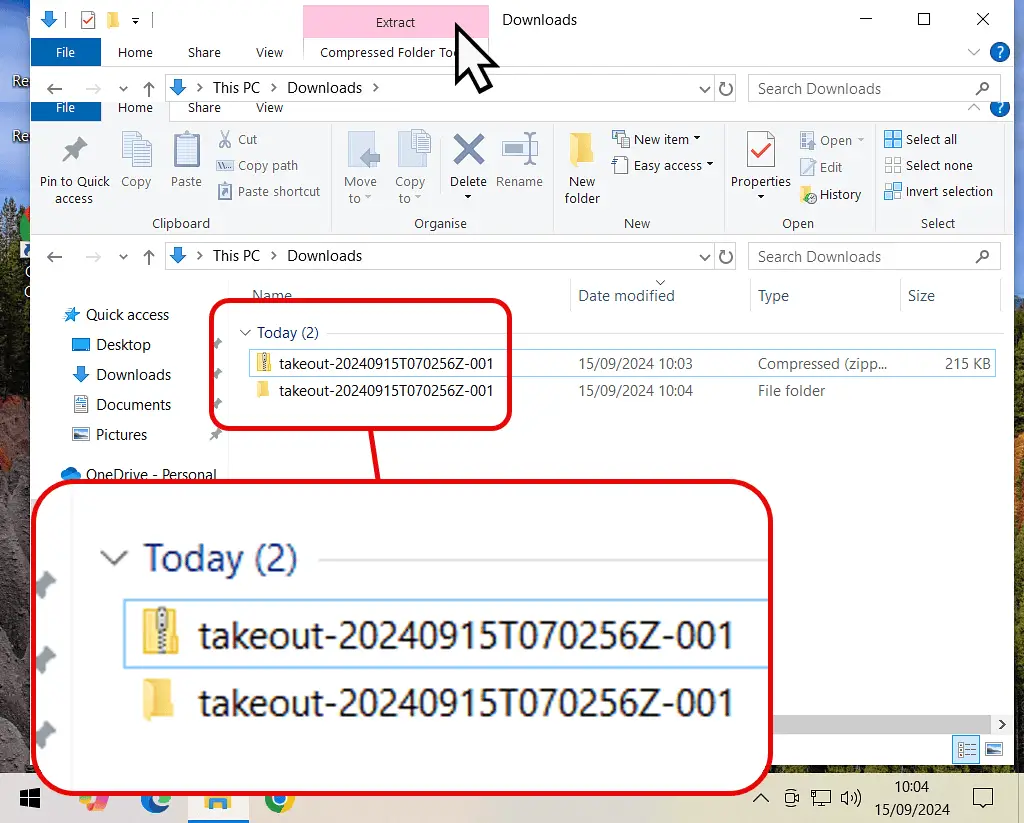
Google Takeout sends your emails as a zipped folder. Thunderbird can’t read inside a zip, so right-click the download, choose Extract All, then click Extract.
Your MBOX file is inside the new folder, a couple of folders down (Takeout, then Mail). Need a hand with zip files? See How To Zip And Unzip Files On A Windows PC.
How to Open an MBOX File in Thunderbird
Thunderbird is a free email program from Mozilla, the people who make the Firefox web browser. It’s free, with no adverts. Using Thunderbird you will need to log in to an email account.
Step 1: Install Thunderbird
Download Thunderbird from thunderbird.net, the official site, and run the installer. Accept the standard settings.
Near the end the installer offers to make Thunderbird your default email program. Untick that if you don’t want email links opening in Thunderbird from now on.
Download It From thunderbird.net
Search results are full of download sites and adverts offering Thunderbird. Some bundle extra software you don’t want. Go straight to thunderbird.net.
Step 2: Set Up an Email Account (You Need One)
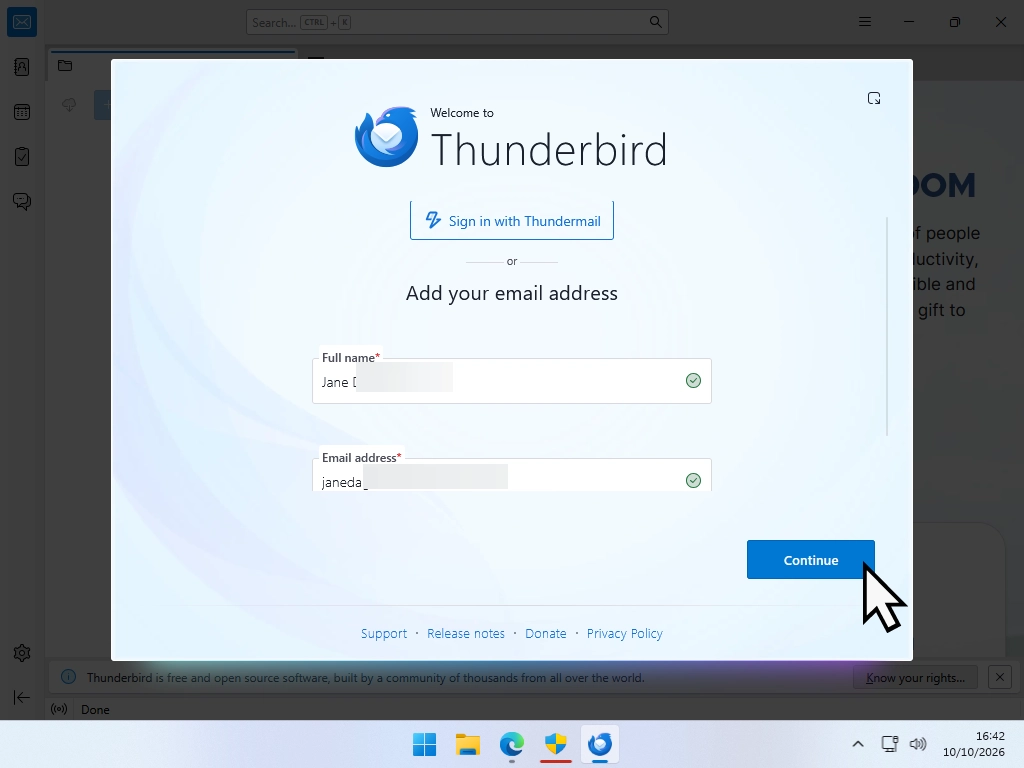
This is the step that catches people out. When Thunderbird opens for the first time it asks you to set up an email account. It’s tempting to cancel, because you only want to open a file.
Don’t cancel. Until Thunderbird has at least one email account, it doesn’t show Local Folders, which is where your imported emails go. Cancel, and the import has nowhere to put them.
Your can use your Gmail account or another account such as Outlook, Yahoo etc:
- Type your name and your email address, and click Continue.
- Thunderbird usually recognises your email address and opens a sign-in window. Sign in and click Allow.
- When Thunderbird says the account has been created, click Finish.
Thunderbird starts downloading your Gmail in the background. That’s normal, and it doesn’t change anything in Gmail itself.
Step 3: Add ImportExportTools NG
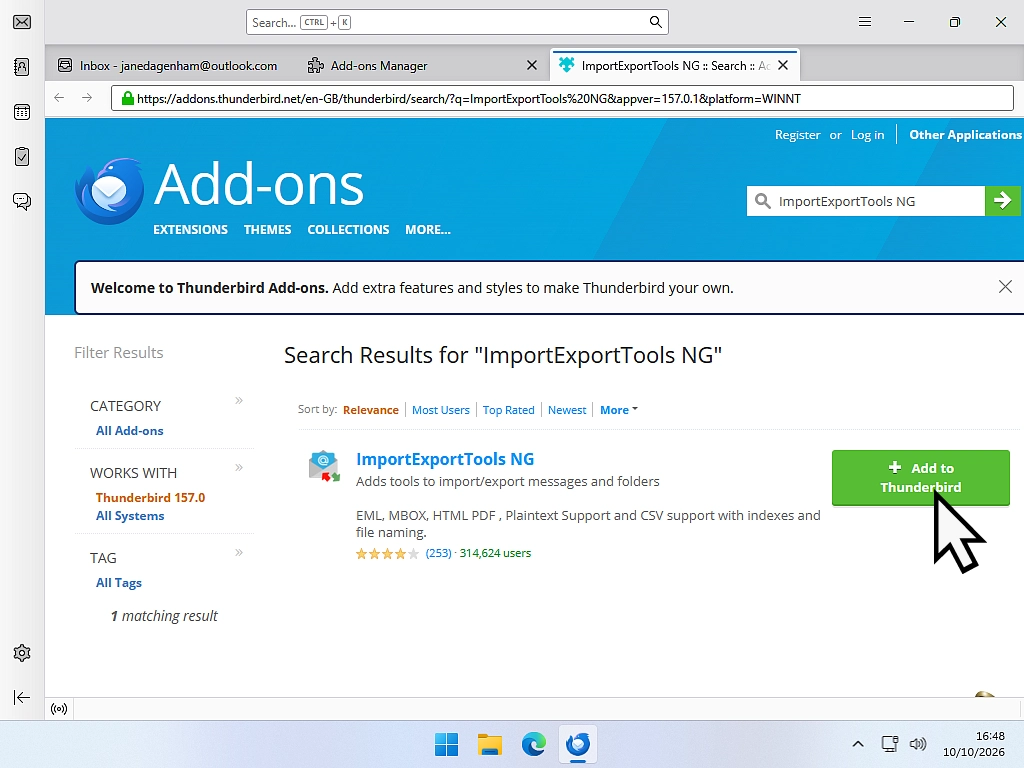
Thunderbird can’t import MBOX files on its own, so you need a free add-on called ImportExportTools NG. It’s listed on Thunderbird’s own add-ons site, so it’s safe to use.
- Click the menu button (three lines) at the top right of Thunderbird and choose Add-ons and Themes.
- In the search box, type ImportExportTools NG and press Enter.
- Click Add to Thunderbird next to ImportExportTools NG.
- Click Add, then OK.
If Thunderbird asks you to restart, do that.
Step 4: Import Your MBOX File
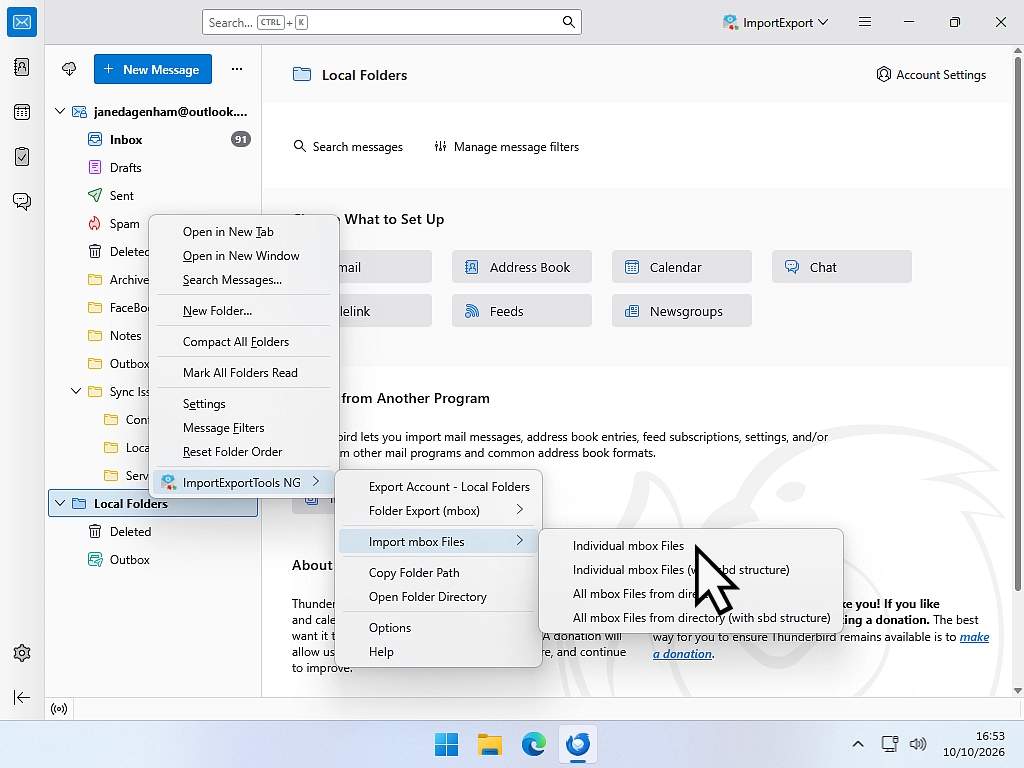
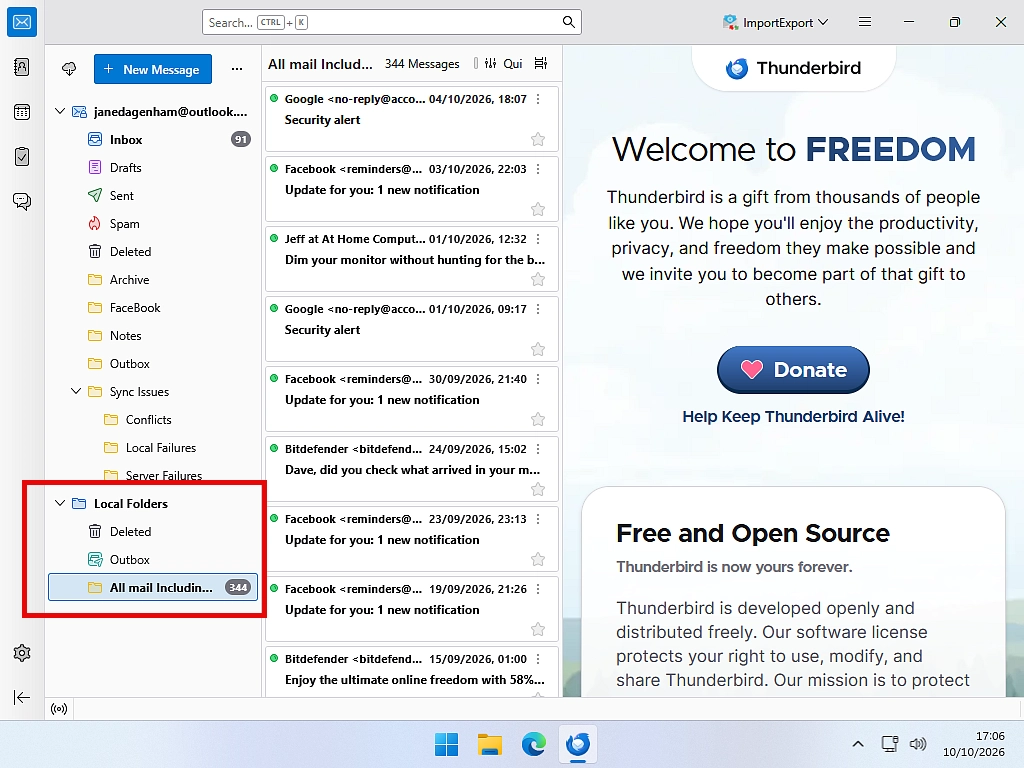
- Go back to your email tab. In the list of folders on the left, find Local Folders.
- Right-click Local Folders, point to ImportExportTools NG, then Import mbox files. Finally click Individual mbox Files.
- Find your MBOX file in the unzipped Takeout folder, click it and click Open.
A big file can take a few minutes. If you’ve got more than one MBOX file, import them one at a time.
Step 5: Read Your Emails
A new folder appears under Local Folders, named after your MBOX file. Click it and there are all your emails, just like an inbox.
Click an email to read it. Attachments open like any other email, and the search box at the top searches everything you’ve imported.
These emails are stored locally on your computer. They aren’t re-uploaded to whichever email service you signed in to. That’s the point of using a local Folder.
How to Save an Email From an MBOX File as a PDF
Need a copy of one email to keep, print or send to someone? Save it as a PDF.
- Open the email in Thunderbird.
- Press Ctrl and P together to print it.
- Choose Microsoft Print to PDF (or Save to PDF) as the printer.
- Click Print or Save, give the file a name and save it.
Got a single email saved as a .eml file rather than an MBOX? How to Convert an EML File to PDF covers that.
Save a Whole Folder of Emails as PDFs
ImportExportTools NG can save every email in a folder as a PDF in one go. Right-click the imported folder, point to ImportExportTools NG, choose the option to export all messages in the folder and pick PDF.
Try it on a small folder first. Thousands of emails means thousands of PDF files.
Can You Open an MBOX File in Gmail?
No. Gmail can’t open or import an MBOX file, and Google Takeout has no restore button. It’s a one-way download.
But if your Gmail account is set up in Thunderbird (Step 2), you can copy emails from the MBOX file back into Gmail:
- Open the imported folder under Local Folders.
- Select the emails you want. Press Ctrl and A together to select them all.
- Right-click them, point to Copy To, then choose your Gmail account and the folder you want them in.
Thunderbird uploads them to Gmail, where they appear in that folder, which Gmail shows as a label. The same works for any other email account you’ve added to Thunderbird.
Two things to bear in mind. A lot of emails takes a long time to upload, so do a few hundred at a time. And they all count towards Gmail’s free 15GB, see Gmail Storage Full? Here’s Why (and How to Fix it).
Another Free Option: eM Client
If you’d rather not set up an email account, eM Client opens MBOX files without one. It has a free version for home use, from emclient.com.
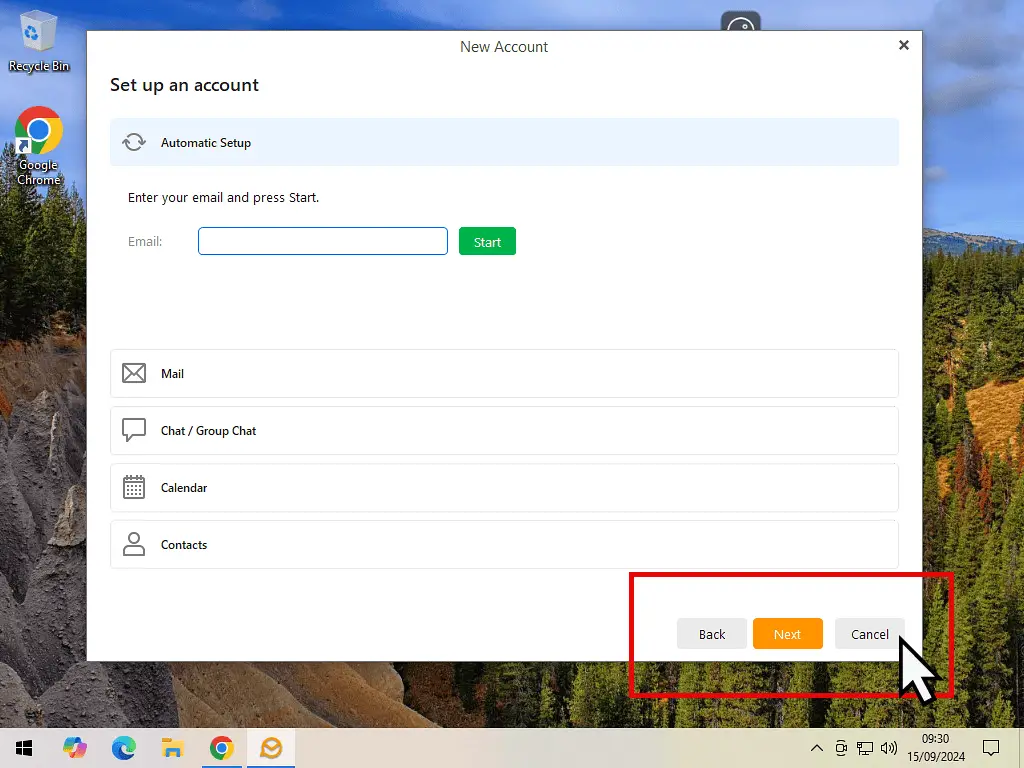
- Install eM Client. When it asks you to set up an email account, click Cancel.
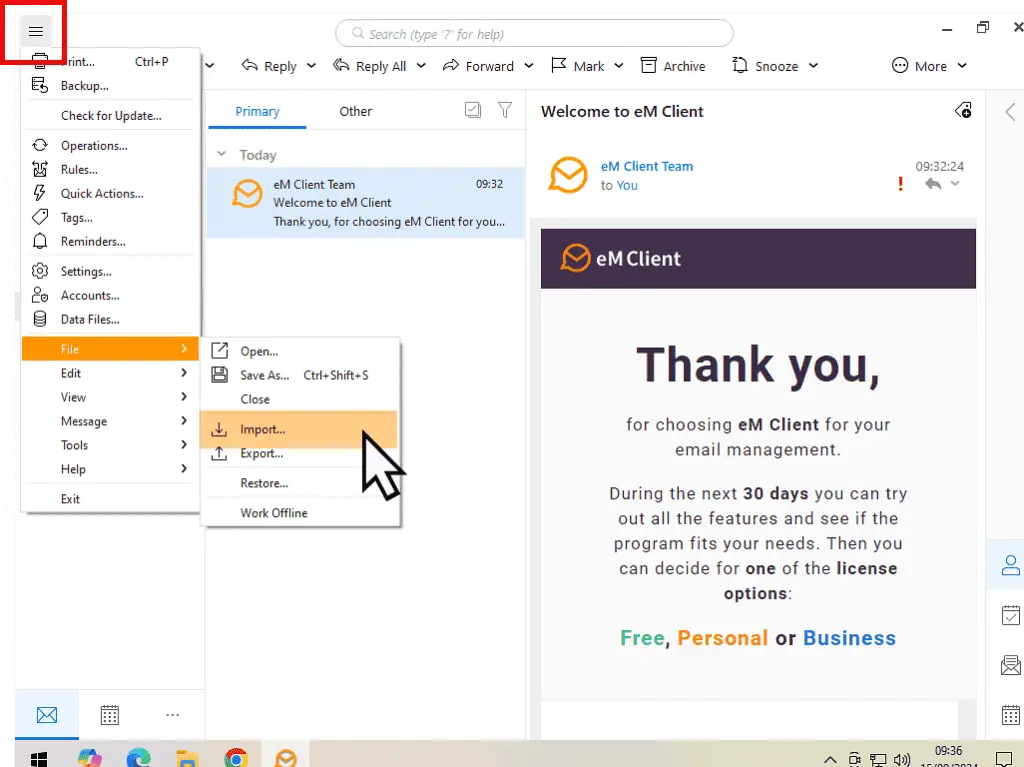
- Click the menu button (three lines) at the top left, point to File and click Import.
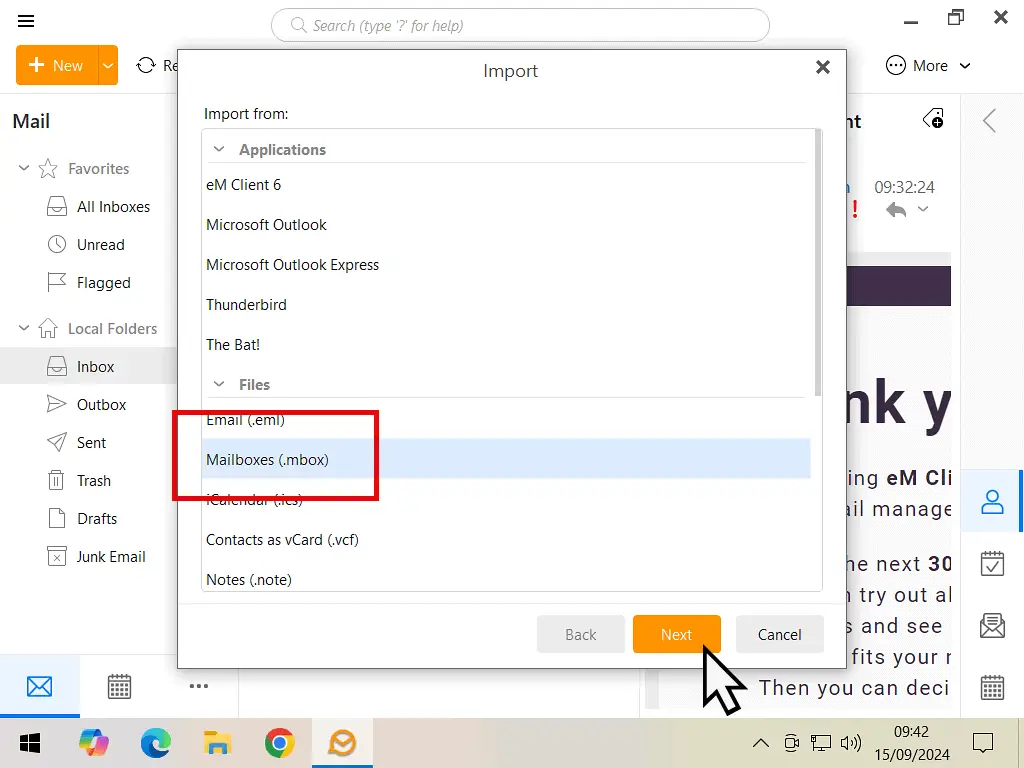
- Choose Mailboxes (.mbox) and click Next.
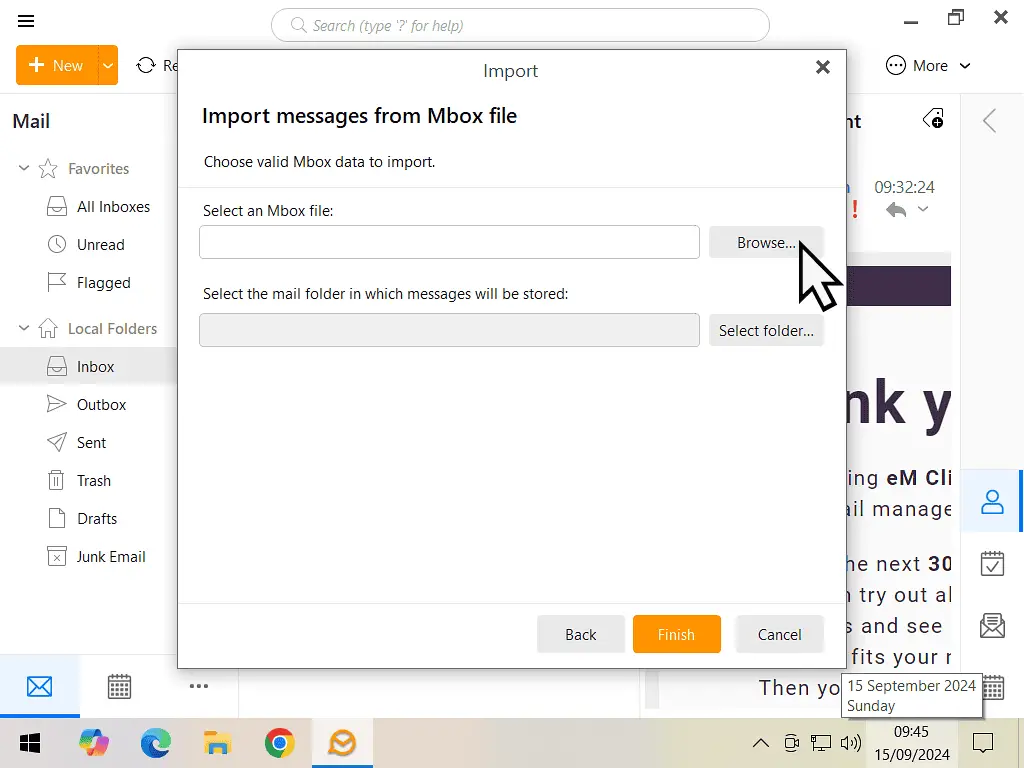
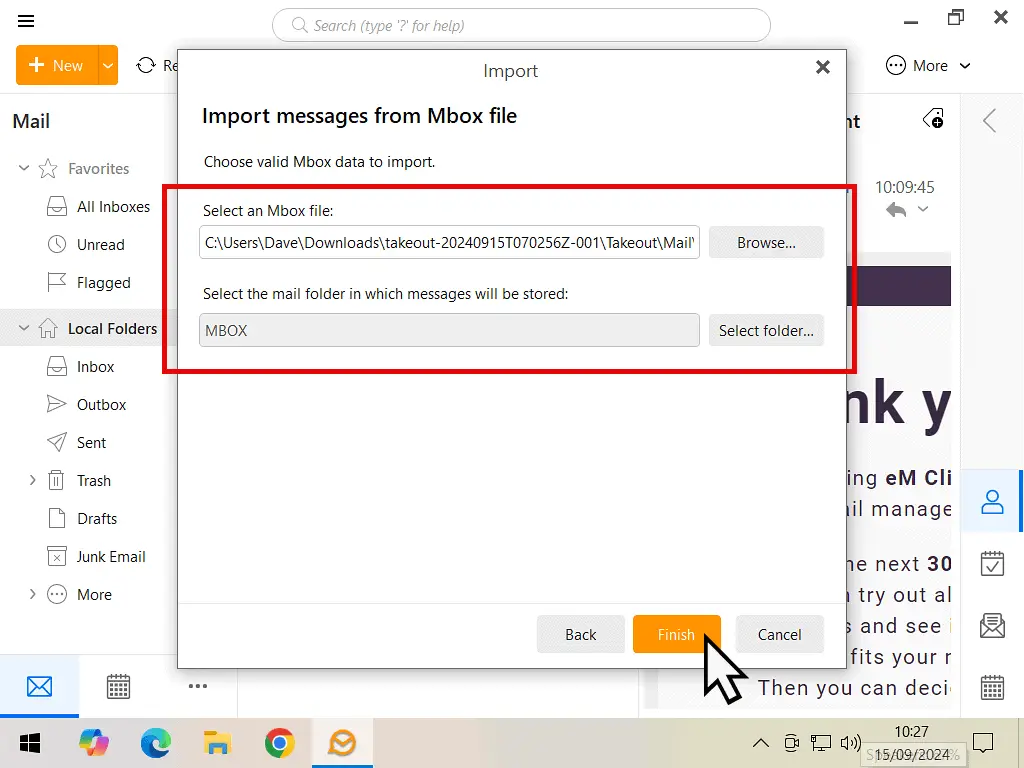
- Click Browse, find your MBOX file and click Open.
- Click Select Folder, click Local Folders, then New Folder. Give it a name and click OK.
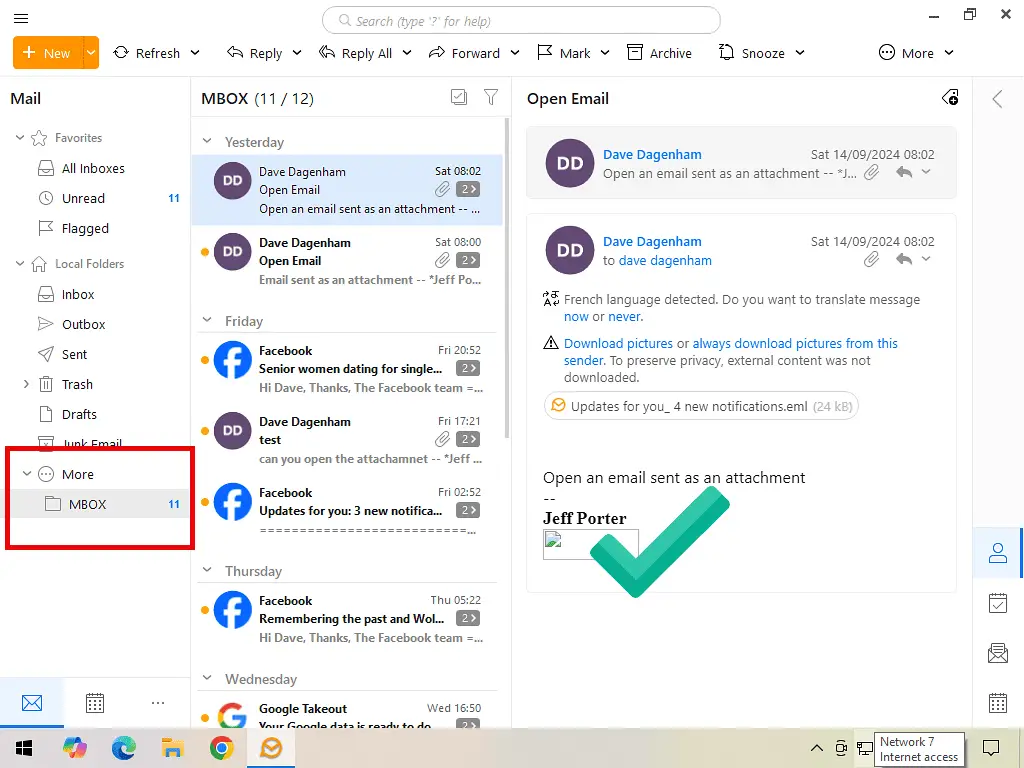
- Click Finish, wait for the import, then open the folder you made.
You may need to click More in the folder list to find the new folder.
Why Not Use an MBOX Viewer App or Website?
Search for an MBOX viewer and the results are full of them. I’d steer clear of most, for two reasons.
You don’t know what you’re installing. Plenty of these programs are fine, but there are an awful lot you really shouldn’t have anywhere near your PC. A lot of the free MBOX viewers are cut-down versions of paid converters, there to sell you the full version.
Online viewers mean uploading your emails. An MBOX file from Google Takeout can hold years of your email: bank statements, medical letters, passwords people have sent you. Uploading all of that to a website you know nothing about is a big risk for no good reason, when Thunderbird does the job on your own computer for free.
Troubleshooting
I Can’t See Local Folders in Thunderbird
You haven’t got an email account set up yet. Click the menu button (three lines), choose Account Settings, then Account Actions at the bottom left and Add Mail Account. Once the account is set up, Local Folders appears.
ImportExportTools NG Isn’t in the Right-Click Menu
Restart Thunderbird after installing the add-on. Then make sure you’re right-clicking Local Folders or a folder inside it, not your email account’s name.
The Import Finished but There Are No Emails
- Did you pick the zip file? Unzip the Takeout download first and choose the .mbox file inside it.
- Is it the right file? A Google Takeout download can contain several MBOX files, one per label. Some labels are empty.
- Big file? Give it a few minutes, then click a different folder and back again to refresh the list.
It’s Taking Ages
A mailbox with years of email can be several gigabytes. Leave Thunderbird to it, and don’t close it until the import has finished.
I Don’t Want My Gmail in Thunderbird Any More
Once you’ve finished, you can remove the account you set up. Go to Account Settings, select your email account, then Account Actions and Remove Account. Your imported emails stay in Local Folders, and nothing in Gmail is deleted.
Frequently Asked Questions
Q: What is an MBOX file?
A: An MBOX file is a whole folder of emails saved as a single file, attachments included. Google Takeout uses it when you download your Gmail.
Q: How do I open an MBOX file on Windows?
A: Use a free email program. Thunderbird with the free ImportExportTools NG add-on opens MBOX files, and so does eM Client. Windows has nothing built in that can read them.
Q: Is there a free MBOX viewer?
A: Yes. Thunderbird is completely free and works as an MBOX viewer and reader once you add the ImportExportTools NG add-on. You don’t need to buy a viewer or converter.
Q: Can I open an MBOX file in Gmail?
A: No. Gmail can’t import MBOX files. You can open the file in Thunderbird and copy the emails back into your Gmail account from there.
Q: Can Outlook open an MBOX file?
A: Not on its own. Open the file in Thunderbird or eM Client instead.
Q: Can I convert an MBOX file to PDF for free?
A: Yes. Open the file in Thunderbird, open the email and print it to Microsoft Print to PDF. ImportExportTools NG can also save a whole folder of emails as PDFs.
Q: How do I open an MBOX file on a Mac?
A: Apple Mail can import it. Open Mail, click File, then Import Mailboxes, choose Files in mbox format and pick your file.
Q: Do I need an email account to open an MBOX file in Thunderbird?
A: Yes, Thunderbird needs at least one email account set up before it shows Local Folders, where the imported emails go. You can remove the account afterwards. eM Client doesn’t need one.
Q: Is it safe to open an MBOX file in an online viewer?
A: I wouldn’t. You’d be uploading your whole email history to a website you know nothing about. Thunderbird does the same job on your own computer for free.
Summary
An MBOX file is just a folder of emails in a single file, and you don’t need to pay anything to open it. Unzip it, install Thunderbird, set up an email account, add ImportExportTools NG and import the file into Local Folders.
From there you can read and search your old emails, save any of them as a PDF, or copy them back into Gmail. And if you’d rather not set up an account, eM Client does the job without one.
Related Posts
How to Download Emails from Gmail
How to Convert an EML File to PDF
How to Delete All Gmail Emails
Gmail is Switching Off Gmailify and Check Email From Other Accounts
Nothing has been switched off yet but if you have emails from different services, such as Yahoo, Outlook etc, sent to your Gmail account, you need to check this.
You can find this and other related step by step guides in – At Home Computer Gmail Guides
Written by Jeff Porter. I’ve been fixing Windows PCs since 2010 and I’m CompTIA Network+ certified. More about me