
Songs showing Unknown artist, Track 1 or a plain music note where the cover art should be? Your MP3s are missing their tags, the hidden details that tell your music player what each song is.
Missing MP3 tags are really common, and more common than ever now that Windows Media Player can’t find album info for the CDs you rip.
The good news is that they’re easy to fix, and it won’t cost you a penny. I’ll show you two free ways to fix missing MP3 tags in Windows 11 and Windows 10:
- File Explorer, for fixing a song or two by hand, with nothing to download.
- MusicBrainz Picard, a free program that fixes whole albums automatically, cover art included.
The Short Version
- For one or two songs, right-click the MP3, click Properties, open the Details tab and type in the missing details.
- For whole albums and cover art, install the free MusicBrainz Picard.
- In Picard, go to Options, File Naming, tick Move files when saving and Rename files when saving, and choose a new Destination directory.
- Click Add Folder, select your music, then click Cluster and Scan.
- Check the album Picard found, then click Save.
MP3 Files Missing Metadata? How to Tell
Missing metadata in MP3 files shows up in a few different ways. The most obvious is when you play a song and there’s no CD cover art in the media player window, just a generic music symbol.
Another is when you look at your music in File Explorer and the Album, Artist or Title columns are empty, or the details are just plain wrong.
You might also see songs named Track 01, Track 02 and so on, sitting in folders called Unknown artist and Unknown album.


What Are MP3 Tags?
MP3 is the most popular file format for music. As well as the sound, every MP3 can carry a small block of information about the song. These are called MP3 tags, ID3 tags or metadata. They’re all the same thing.
A song’s tags hold details such as the title, artist, album, track number, year, genre and the album cover art.
Your music player, phone and car stereo read the tags to show what’s playing and to sort your music into albums. The file name doesn’t matter much. If the tags are blank, you get Unknown artist, however well the file is named.
Why Windows Media Player Can’t Find Album Info Any More
If you rip your CDs with Windows Media Player, this is probably why you’re here.
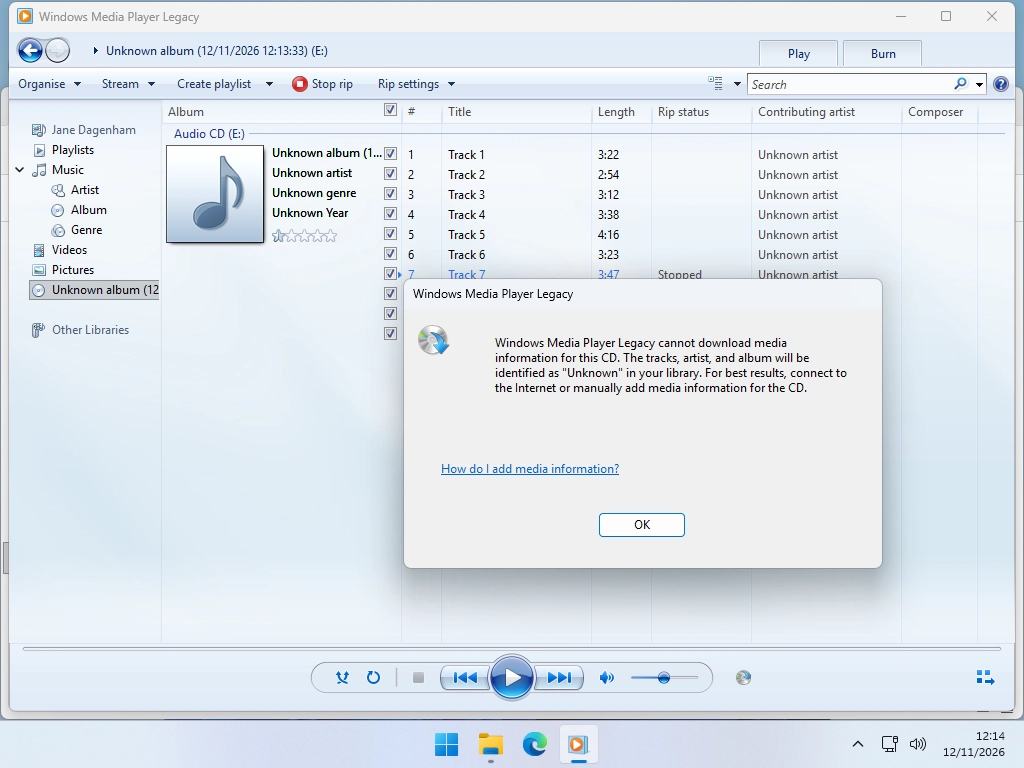
Windows Media Player used to look up every CD you put in and fill in the album name, artist, track names and cover art for you. Some time before Christmas 2025, the Microsoft service behind it stopped working.
It affects both Windows Media Player Legacy and the newer Media Player app in Windows 11. Find album info comes back empty, and the new app says “We couldn’t connect to the service. Check your internet connection, then try again”, even when your internet is fine.
Microsoft hasn’t said a word about it, and people were still reporting the problem on Microsoft’s own help forum in August 2026.
Ripping itself still works, in the new Media Player app and in Windows Media Player Legacy. The songs just come out with no names and no cover art. There’s nothing wrong with your PC or your CD, and the fix below works for them just like any other MP3.
Other Reasons MP3 Tags Go Missing
- Online converter sites. MP3s made on YouTube converter and free download sites often have no tags at all, or the website’s name stuffed into the title.
- Old CD rips. Music ripped years ago with programs that didn’t look anything up.
- Music copied from another program. Some music programs keep details such as cover art in their own library rather than in the file, so when you copy the songs to a phone or USB stick, the details stay behind.
Quick Fix: Edit MP3 Tags in File Explorer (No Download)
If only one or two songs need fixing, you can edit MP3 metadata in Windows 11 and Windows 10 without installing anything. File Explorer can do it.
- Open File Explorer and go to the folder with your music.
- Right-click the MP3 and click Properties.
- Click the Details tab.
- Click in the space next to Title, Contributing artists, Album, Year, # (the track number) or Genre, and type the right details.
- Click OK to save the new tags.
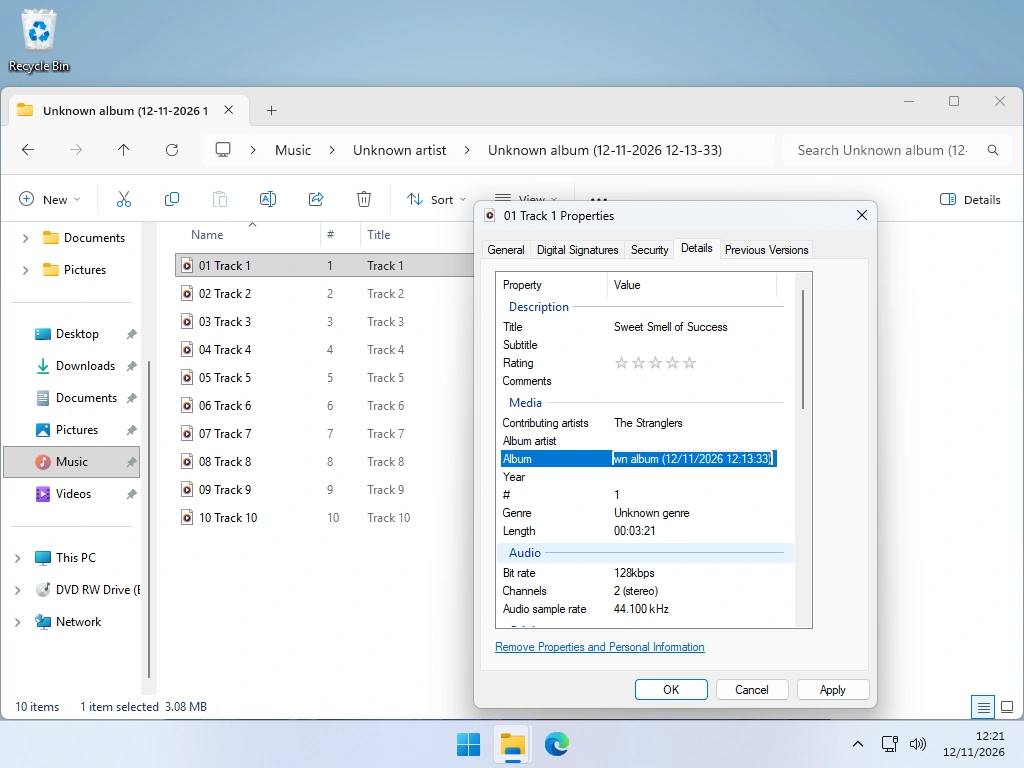
To give a whole album the same album name, select all the songs first, then right-click one of them and choose Properties. Whatever you type in Album goes into every song at once.
Quick Tip
Where the selected songs have different details, the box says (Multiple values). Leave those boxes alone and only fill in the ones that should be the same for every song.
File Explorer can’t add cover art, and typing every track name for a 15 song album gets old fast. For whole albums, Picard is much quicker.
Fix Missing MP3 Tags Automatically With MusicBrainz Picard
My favourite way to fix missing MP3 tags is a free program called MusicBrainz Picard.
Picard works out an audio fingerprint for each song, a bit like Shazam does on your phone. Then it matches it against MusicBrainz, a huge free music database run by a non-profit.
In one go, it fills in the title, artist, album, track number and year, and adds the cover art. It’s free and open source, has no adverts, and it doesn’t upload your music anywhere.
Download and Install MusicBrainz Picard
Download Picard from the official site at picard.musicbrainz.org, or search for MusicBrainz Picard in the Microsoft Store. Picard 3 needs Windows 10 or Windows 11.
Either is fine. I’d use the Microsoft Store version, because it keeps itself up to date.
Only download it from those two places, not from download sites that bundle extra software with it. If you’re new to this, my guide on downloading safely from the internet walks you through it.

Change Two Settings Before You Start
Once Picard is installed, open it. Before you add any music, change a couple of settings so Picard saves your fixed MP3s into a new folder.
- Click Options on the menu bar, then click Options on the drop-down menu.
- Click File Naming in the left-hand list.
- Tick Move files when saving and Rename files when saving.
- Under Destination directory, click Browse and choose a new, empty folder for your fixed music. You can create a new folder right there in the Browse window.
- Click Make It So! at the bottom of the window to save the changes.


Why These Changes?
These settings let Picard rename your MP3 files and save them into a different folder from the one they’re in now.
That matters, because sometimes saving back into the same folder just won’t work.
How to Add Missing MP3 Tags
Make a Copy First
Before you start, make a copy of your music folder and work on the copy. A quick copy and paste is all it takes.
Picard moves and renames the songs it saves, and things can go wrong. With a copy, your original MP3s stay safe until you’re happy with the result.
- In Picard, click Add Folder on the toolbar to add a whole album, or Add Files to add single songs.
- Find your copy of the music folder, select it and click Select Folder.
- Your MP3s appear in the left-hand pane, under Unclustered Files.


Unclustered Files
Unclustered Files just means Picard hasn’t grouped your songs into an album yet. At the moment, each one is on its own.
If the songs all come from the same album or CD, click Unclustered Files to select it, then click the Cluster button. That tells Picard the MP3s belong together.
If they come from lots of different albums, skip the Cluster button. Select the songs and go straight to Scan in the next step, and Picard will match each song on its own.


Adding Missing Metadata and CD Artwork
- Click the cluster to select it, then click the Scan button. It can take a minute or two for Picard to find a match.
- The album Picard finds appears in the right-hand pane. Click the small arrow beside the album title to see the tracks.
- Click a track. Across the bottom of the window you’ll see each tag, with its old value and new value side by side. Blank tags get filled in.
- Check the CD artwork in the bottom right-hand corner.
- If everything looks right, select the album and click Save.


Lookup or Scan?
If your songs already have the right artist and album, and only the cover art or track numbers are missing, click Lookup instead. It’s quicker, because Picard searches using the details that are already there.
Scan is the one to use when the tags are blank or wrong, because it identifies each song from the sound itself.
Fixed MP3 Metadata
When you click Save, Picard adds the missing metadata and cover art to each song and moves it into the Destination directory you chose earlier.
Check Your Fixed MP3s
Open your Destination directory in File Explorer. Picard puts each album in its own folder, named after the artist and album.
Switch the view to Large icons to see the cover art, or to Details to see the Title, Album and track number columns filled in.
Fixing Problems With the Metadata
Sometimes you’ll run into problems when adding tags to your MP3s. The most common is that the number of tracks doesn’t match, or the track listing is slightly different from your CD.
Wrong Number of Tracks or the Wrong Version of the Album
In the example below, Picard’s version of the album has 6 more tracks than the CD. Look at the album title and you’ll see 12/18 in brackets. That means 12 of the 18 tracks have been matched.
It happens because albums are released and re-released with different track listings, such as deluxe editions, remasters and versions for different countries.
To fix it, right-click the album title, hover your mouse pointer over Other versions, then pick the version that matches your CD. Look for the same number of tracks, and the same year and country if you know them.


Changing the Cover Artwork
Another common problem is the wrong cover art, or no artwork at all.
First, try another version of the album using Other versions, as above. Different versions often have different artwork.
If that doesn’t help, search Google Images for the album cover and save the picture to your PC. Then drag and drop it onto the cover art box in Picard, and click Save.


Troubleshooting
Tags Show in Picard but Not in My Car or Music Player
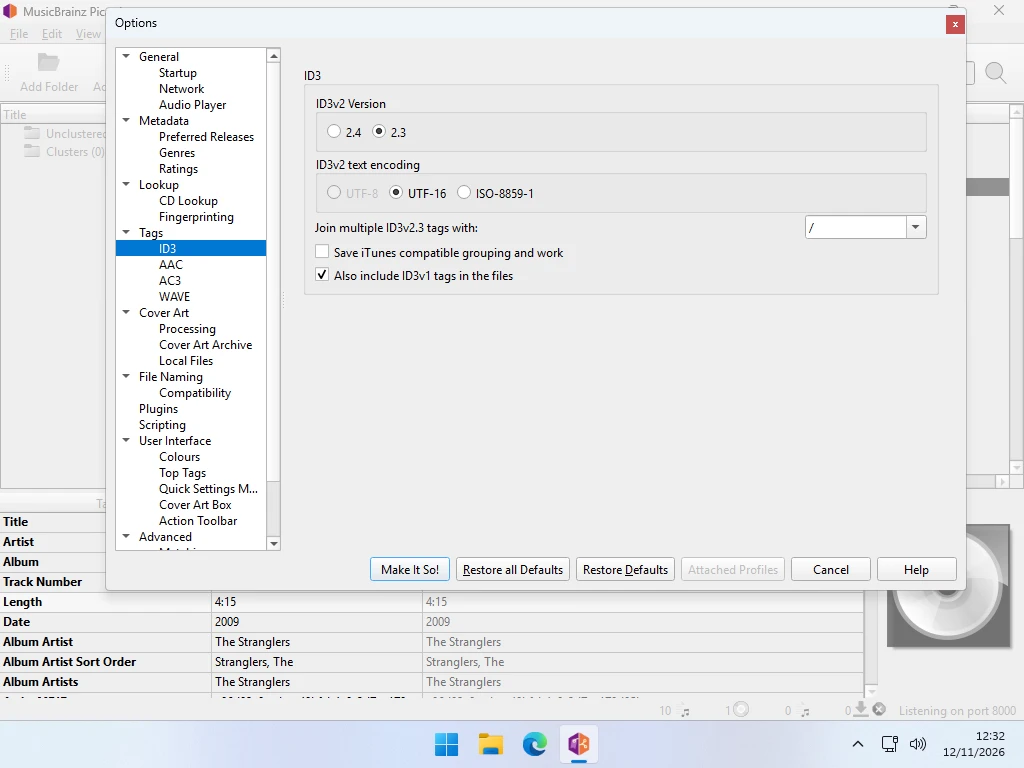
Picard saves tags in the newest format, called ID3v2.4. Most players read it fine, but some car stereos, older players and older software don’t.
In Picard, open Options, find the ID3 page under Tags, and change the ID3v2 version to 2.3. Then put the songs through Picard again and save them. If you’re making a disc for the car, my guide on how to make an MP3 CD covers the rest.
Cover Art Doesn’t Show in File Explorer
File Explorer only shows cover art in an icon view, such as Medium icons or Large icons. In Details or List view, you’ll only ever see a plain music icon.
If it still doesn’t appear, thumbnails may be switched off. My guide on how to show thumbnails shows you how to turn them back on.
Can’t Edit MP3 Details in File Explorer
- Close your music player. Windows won’t change a song that’s playing or open in another program.
- Copy the songs off the CD first. You can’t change the tags on songs that are still on a disc.
- Check the file isn’t read-only. Right-click it, click Properties, and on the General tab untick Read-only.
Picard Can’t Find My Album
If Scan finds nothing, type the artist and album into the File Explorer Details tab, then try Lookup in Picard instead.
Very rare albums, bootlegs and home recordings may not be in the MusicBrainz database at all. For those, type the details in yourself using File Explorer.
Frequently Asked Questions
Q: Is MusicBrainz Picard free?
A: Yes. Picard is completely free and open source, with no adverts and no paid version. It’s made by the non-profit MetaBrainz Foundation.
Q: Is Mp3tag free?
A: Yes, on Windows. Mp3tag is free for Windows. The Mac version is a paid app. It’s a good choice if you’d rather edit tags by hand, although Picard is better at filling them in automatically.
Q: Why can’t Windows Media Player find album info any more?
A: The Microsoft service Windows Media Player used to look up album details stopped working around the end of 2025. It affects Windows Media Player Legacy and the new Media Player app. Ripped CDs now come out with no track names or cover art, which you can fix for free with MusicBrainz Picard.
Q: Can I edit MP3 metadata in Windows 11 without extra software?
A: Yes. Right-click the MP3 in File Explorer, click Properties, then open the Details tab. You can type in the title, artist, album, year, track number and genre. File Explorer can’t add cover art, though.
Q: How do I add album art to an MP3?
A: In MusicBrainz Picard, scan the song and Picard adds the cover art automatically. If it finds the wrong cover, save the right picture to your PC and drag it onto the cover art box, then click Save.
Q: Should I use an online MP3 tag editor?
A: You can, but you have to upload your music to someone else’s website and download it again, usually one song at a time. Picard fixes whole albums on your own PC, for free, without uploading your music.
Q: Does fixing MP3 tags change the sound quality?
A: No. Tags are stored separately from the sound, so adding or changing them doesn’t touch the audio at all.
Q: Does Picard work with FLAC, WMA and M4A files too?
A: Yes. As well as MP3, Picard can tag FLAC, WMA, M4A and most other common music formats.
Summary
Missing MP3 tags are easy to fix, and you don’t need to pay for anything. For a song or two, use the Details tab in File Explorer. For whole albums and cover art, use MusicBrainz Picard.
With Windows Media Player no longer finding album info, Picard is now also the easiest way to name the CDs you rip.
Properly tagged music sorts properly in every player, shows the song and artist on your car stereo and phone, and lets your player build playlists like “all rock songs from the 80s”.
Once your music is tagged, you can copy it to a USB stick for the car and everything will show up just as it should.
Related Posts
Copy a CD to Your Computer Without Any Loss of Sound Quality
Make pitch perfect copies of your CD collection.
How to Burn a Music CD in Windows 11 and 10
Create your very own “mix tapes” on CD.
How to Make an MP3 CD
Did you know you can burn MP3s to a CD? They’ll play in most modern CD players.
How to Use Windows Media Player Legacy
Still prefer the old Windows Media Player to Microsoft’s new app? You’re not alone.
A beginner’s guide to the classic Windows Media Player in Windows 11 and 10: play music, rip CDs and build playlists.
You can find this and other related step by step guides in – At Home Computer Audio and Video Guides
Written by Jeff Porter. I’ve been fixing Windows PCs since 2010 and I’m CompTIA Network+ certified. More about me