
CHKDSK (Check Disk) is a free tool included with every version of Windows that scans and repairs hard drive errors.
It’s a great tool, but sometimes CHKDSK won’t work. It shows an error message instead of scanning, gets stuck part way through, runs every time you start your PC, or you can’t get into Windows to run it at all.
In this guide I’ll go through the common CHKDSK errors one by one, with free fixes that don’t need any extra software. If you just want to run a normal scan, see my guide on how to use CHKDSK first.
The Short Version
- Cannot continue in read-only mode: add /f to the command.
- Volume is in use by another process: type Y and restart. That one’s normal.
- Not available for RAW drives: rescue your files first, then format the drive.
- Cannot open volume for direct access: close other programs, reconnect the drive, or use Safe Mode.
- Write protected: check the lock switch on the card or stick.
- Stuck: check the drive light and give it time.
- Windows won’t start: run CHKDSK from the Windows Recovery Environment.
Table of contents
- Errors Found. CHKDSK Cannot Continue in Read-Only Mode
- CHKDSK Is Not Available for RAW Drives
- Cannot Open Volume for Direct Access
- Windows Cannot Run Disk Checking on This Volume Because It Is Write Protected
- File Record Segment Is Unreadable
- CHKDSK Is Stuck
- CHKDSK Runs Every Time You Start Your PC
- Scheduled CHKDSK Doesn’t Run at Restart
- CHKDSK Won’t Start at All
- How to Run CHKDSK When Windows Won’t Start
- When to Stop and Copy Your Files Off
- Frequently Asked Questions
- Summary
Errors Found. CHKDSK Cannot Continue in Read-Only Mode
This is the easiest one to fix. It means CHKDSK found problems but wasn’t told to fix them.
If you type chkdsk and a drive letter on its own, CHKDSK only checks the drive and reports back. It needs the /f switch before it’s allowed to make repairs.
Open Command Prompt as an administrator and run the command again with /f on the end, using your own drive letter:
chkdsk e: /fIf it’s your C: drive, you’ll be asked to schedule the check for the next restart. Type Y, press Enter and restart.
CHKDSK Is Not Available for RAW Drives
The full message reads:
The type of the file system is RAW.
CHKDSK is not available for RAW drives.
RAW means Windows can’t recognise the drive’s file system at all. Its index of files is damaged or missing, so there’s nothing for CHKDSK to check. It usually comes with Windows asking you to format the disk before you can use it.
Don’t format it yet if there are files on the drive you want. Formatting gives you a working drive again, but it wipes the files.
- If the drive came from a Mac, a TV recorder or a camera, it may simply use a format Windows can’t read. Check it on the device it came from first.
- If you need the files, recover them first. PhotoRec and TestDisk are free, open source tools that can rescue files and rebuild lost partitions, and you don’t need to buy anything.
- Once your files are safe, format the drive in File Explorer or Disk Management and it will work again.
If the drive doesn’t show up in This PC at all, rather than showing as RAW, see my guide to fixing a hard drive that’s not showing up.
Cannot Open Volume for Direct Access
CHKDSK needs the drive all to itself. This message means something else got in first, or the drive isn’t answering properly. It’s most common on USB sticks, memory cards and external drives.
Try these, in this order:
- Close every program that might be using the drive, including File Explorer windows showing it.
- Safely remove the drive, plug it back in, and run CHKDSK again. Try a different USB port, cable or card reader too.
- Restart your PC and try again before opening anything else.
- Backup software, disk monitoring tools and third party antivirus can lock a drive. Pause them, or start the PC in Safe Mode, where they don’t load.
- Run CHKDSK from the Windows Recovery Environment (steps further down), where nothing else is running.
If none of that works, the drive itself may be failing. Copy anything you need off it while you still can.
Windows Cannot Run Disk Checking on This Volume Because It Is Write Protected
Write protected means Windows can read the drive but isn’t allowed to change it, and CHKDSK can’t fix a drive it can’t write to.
Check the lock switch first. SD cards, SD adapters and some USB sticks have a tiny slider on the side. Slide it away from the Lock position, then plug the card back in.
If there’s no switch, the drive may have been marked read-only in Windows. You can clear that with Diskpart. Open Command Prompt as an administrator and type these one at a time, pressing Enter after each:
diskpart
list disk
select disk 2
attributes disk clear readonly
exit
Be Careful With Diskpart
Replace 2 with the number of your USB stick or card from the list. Check the size so you’re sure you’ve got the right disk. Diskpart doesn’t ask ‘are you sure?’
Some flash drives and memory cards lock themselves read-only when they start to fail, to protect your files. Nothing will unlock those. Copy your files off and replace the drive.
File Record Segment Is Unreadable
If a CHKDSK scan fills the screen with lines like File record segment 4702 is unreadable, CHKDSK can’t read parts of the drive’s master index of files.
That nearly always means bad sectors, and it’s one of the clearest signs that a hard drive is starting to fail. It can happen on SSDs too.
- Copy your important files off first, before anything else.
- Then run chkdsk /r once to recover what it can, and let it finish.
- Plan to replace the drive, even if the scan finishes and everything seems fine again.
CHKDSK Is Stuck
When CHKDSK runs at startup you’ll see a screen saying something like Scanning and repairing drive (C:) with a percentage. It often looks stuck when it isn’t.
A chkdsk /r scan reads every part of the drive, and on a large hard drive that can take hours. It can sit on the same percentage for a long time, especially near the end or on a drive with problems.
Check the drive light on the front of the PC or the side of the laptop. If it’s still flickering, CHKDSK is still working. Leave it, overnight if need be.
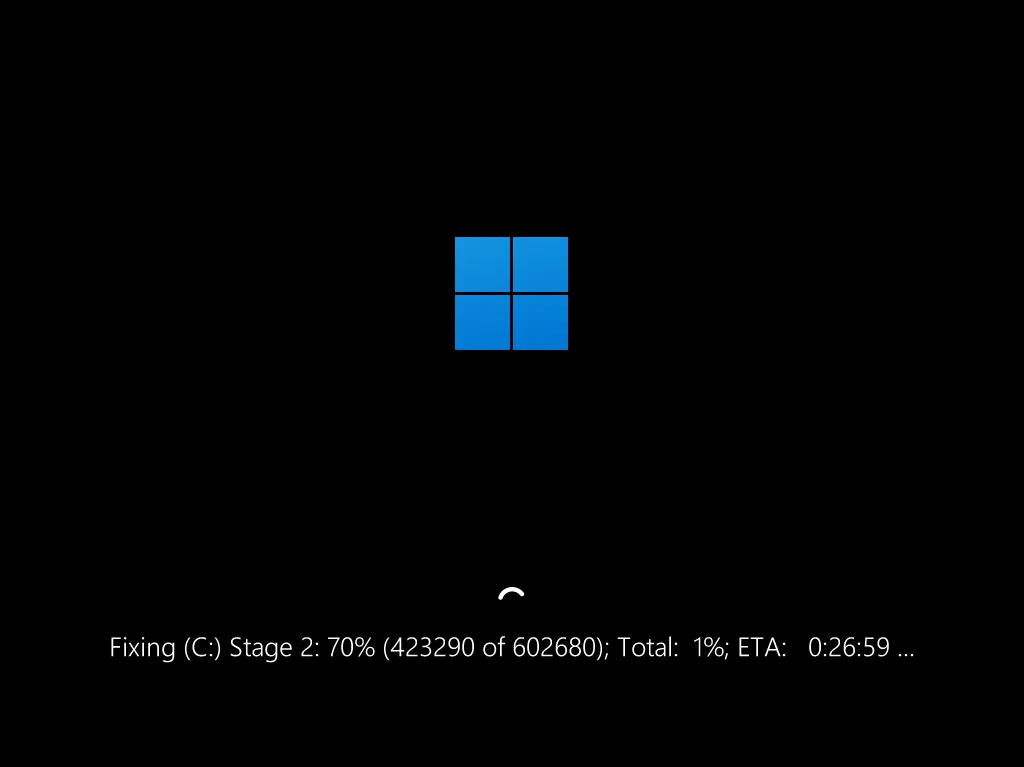
If the light has stopped and nothing has changed for several hours, hold the power button to switch off. Then:
- Start the PC and copy any important files off if you can.
- Run CHKDSK again, from Safe Mode or the Windows Recovery Environment (steps below).
- If it sticks in the same place again, the drive is very likely failing.
Don’t Switch Off Too Soon
Only switch off part way through when you’re sure CHKDSK has stopped. Cutting it off while it’s writing repairs can leave the file system in a worse state.
CHKDSK Runs Every Time You Start Your PC
Windows runs CHKDSK automatically at startup if the drive is marked as dirty. That flag gets set when files weren’t saved properly, for example after a power cut or the PC being switched off at the wall.
Normally the check runs once, fixes the problem and clears the flag. If it keeps coming back, check whether the drive is still marked as dirty. In Command Prompt as an administrator, type:
fsutil dirty query c:If it says the volume is Dirty, run a full fix so the check can finish properly:
chkdsk c: /fType Y, restart, and let it run to the end without interrupting it.
You can also see whether a check has been booked for the next restart:
chkntfs c:If CHKDSK has been scheduled, it says so. If not, you’ll see C: is not dirty.
Stop CHKDSK at Startup
If you need to skip a scheduled check, this tells Windows not to check C: at the next startup:
chkntfs /x c:To put things back to normal afterwards, use:
chkntfs /dQuick Tip
Skipping the check hides the warning, it doesn’t fix anything. If CHKDSK keeps finding errors on every startup, the drive is telling you something. Back up your files and plan to replace it.
Scheduled CHKDSK Doesn’t Run at Restart
You typed Y to schedule the scan, but nothing happened when the PC started again.
- Make sure you chose Restart, not Shut down. With Fast Startup turned on, shutting down isn’t a full restart. I explain why in how to turn your computer off properly.
- Run chkntfs c: to check the scan is still booked. If not, schedule it again.
- If Windows shows Scanning and repairing drive for a moment and then skips straight to the desktop, run CHKDSK from the Windows Recovery Environment instead.
CHKDSK Won’t Start at All
If CHKDSK doesn’t run at all, crashes, or Windows says it can’t find it, the problem may be damaged Windows system files rather than the drive.
Try the System File Checker (SFC). It scans and repairs Windows’ own files, and there’s a very good chance it will sort out the problems you’re having with CHKDSK.
Open Command Prompt as an administrator and type:
sfc /scannowPress Enter and wait for the scan to finish. Restart your PC and try CHKDSK again. With a bit of luck, all will be well.

If SFC can’t fix everything, run this command next, then run SFC once more:
DISM /Online /Cleanup-Image /RestoreHealthI have full guides to System File Checker and DISM if you’re unfamiliar with them.
How to Run CHKDSK When Windows Won’t Start
If SFC didn’t help, or your computer won’t start up far enough to run it, you can run CHKDSK from outside Windows.
From the Windows Recovery Environment (WinRE)
The Windows Recovery Environment (WinRE) is a separate, cut down version of Windows that lives on a hidden recovery partition of your drive. Because your normal Windows isn’t running, nothing is using the drive, so CHKDSK can get to work.
Windows 11: click Start, Settings, System, Recovery, then Restart now next to Advanced startup.
Windows 10: click Start, Settings, Update & Security, Recovery, then Restart now under Advanced startup.
If Windows won’t start, it usually opens the Recovery Environment by itself after two or three failed starts. My guide on how to access the Windows Recovery Environment has more ways in.
When the blue menu appears, click Troubleshoot, Advanced options, Command Prompt.

If your drive is encrypted with BitLocker or device encryption, you’ll be asked for your recovery key at this point.
Find your Windows drive letter first. In the Recovery Environment, Windows is often not on C:. Type this and press Enter:
bcdeditLook under Windows Boot Loader for the line that starts osdevice. The letter after partition= is your Windows drive, for example D:.
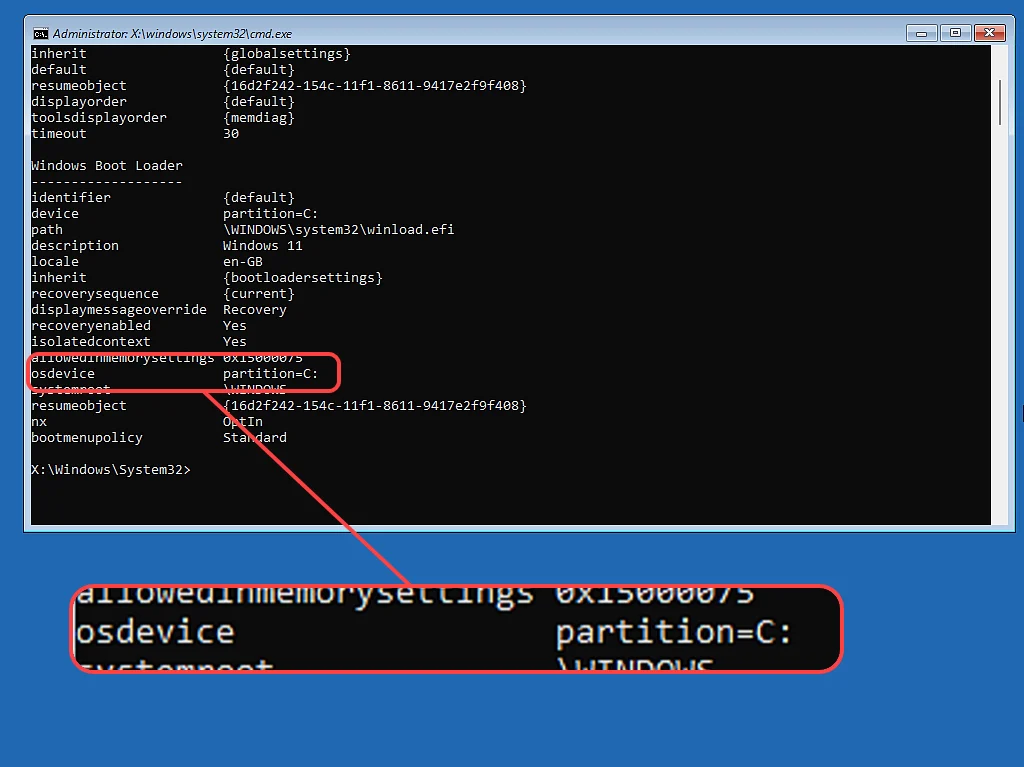
Now run CHKDSK on that drive letter:
chkdsk d: /r
CHKDSK starts examining your drive for errors. When it’s finished, close Command Prompt and click Continue to start Windows normally.

From a Windows Installation USB
If the Recovery Environment won’t open either, start the PC from a Windows 11 bootable USB drive. When the first setup screen appears, press Shift + F10 to open Command Prompt.
Then use bcdedit to find your Windows drive letter and run CHKDSK in exactly the same way.
Run CHKDSK in Safe Mode
If Windows starts but CHKDSK keeps getting blocked, try starting Windows in Safe Mode. Only the bare essentials load, so there’s far less to get in CHKDSK’s way. Open Command Prompt as an administrator and run CHKDSK as normal.
When to Stop and Copy Your Files Off
CHKDSK can fix file system errors and work around a few bad sectors, but it can’t repair a drive that’s wearing out. These are the signs to stop running scans and rescue your files:
- Clicking, grinding or buzzing noises from a hard drive
- More bad sectors every time you run CHKDSK
- Lots of File record segment is unreadable lines
- Scans that get stuck in the same place every time
- A drive that goes RAW, disappears or turns read-only on its own
The free program CrystalDiskInfo reads the health report built into your drive and shows it as Good, Caution or Bad. Caution or Bad means copy your files off now.
Then set up a proper Windows backup on the new drive, so it never matters if a drive fails again.
Frequently Asked Questions
Q: Why is CHKDSK not working?
A: Usually another program is using the drive, the drive has a file system Windows can’t read (RAW), it’s write protected, or it’s failing. Damaged Windows files can also stop CHKDSK starting, which SFC can fix.
Q: What does CHKDSK cannot continue in read-only mode mean?
A: CHKDSK found errors but wasn’t told to fix them. Run it again as an administrator with /f on the end, for example chkdsk e: /f.
Q: Why does CHKDSK say my drive is RAW?
A: Windows can’t recognise the drive’s file system, so CHKDSK has nothing to check. Recover your files first, then format the drive to use it again.
Q: Can CHKDSK recover deleted files?
A: No. CHKDSK repairs the drive’s file system. It doesn’t bring back files you’ve deleted. For those you need a recovery tool such as PhotoRec.
Q: How do I stop CHKDSK running at every startup?
A: Let it finish once with chkdsk c: /f. If you need to skip a check, chkntfs /x c: stops it at the next startup, and chkntfs /d puts things back. If it keeps finding errors, the drive may be failing.
Q: Is it safe to turn off my PC while CHKDSK is running?
A: Only if you’re sure it has stopped. If the drive light is still flickering, leave it. Switching off while it’s writing repairs can make things worse.
Q: How do I run CHKDSK if Windows won’t start?
A: Open the Windows Recovery Environment, choose Troubleshoot, Advanced options, Command Prompt, use bcdedit to find your Windows drive letter, then run chkdsk with that letter.
Q: Can I run CHKDSK in Safe Mode?
A: Yes. Start Windows in Safe Mode, open Command Prompt as an administrator and run CHKDSK as normal. It’s useful when other programs keep locking the drive.
Summary
When CHKDSK isn’t working, the message it gives you usually points straight at the fix. Read-only mode needs /f, RAW drives need their files rescuing before a format, and write protected drives often just need a switch flicking.
If Windows itself is the problem, SFC and DISM can repair it, and the Windows Recovery Environment lets you run CHKDSK even when Windows won’t start.
And if the errors keep coming back, take the hint. Copy your files off and replace the drive before it fails completely.
Related Posts
How to Use CHKDSK (Check Disk) in Windows 11 and 10
Run a normal CHKDSK scan, choose /f or /r, and find the results.
How to Run System File Checker (SFC)
Repair damaged Windows files that stop tools like CHKDSK working.
How to Access the Windows Recovery Environment (WinRE)
Every way into Windows’ built-in repair tools, even when it won’t start.
How to Use Disk Management
Format drives, change drive letters and resize partitions with the tool built into Windows
You can find this and other related step by step guides in – At Home PC Tech Guides
Written by Jeff Porter. I’ve been fixing Windows PCs since 2010 and I’m CompTIA Network+ certified. More about me